
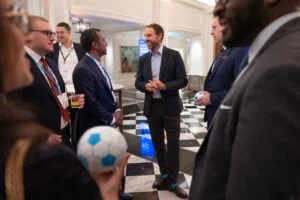
Gareth Southgate Brings Leadership Insight to Barclays Global QIS Conference
5 days ago


 United Kingdom
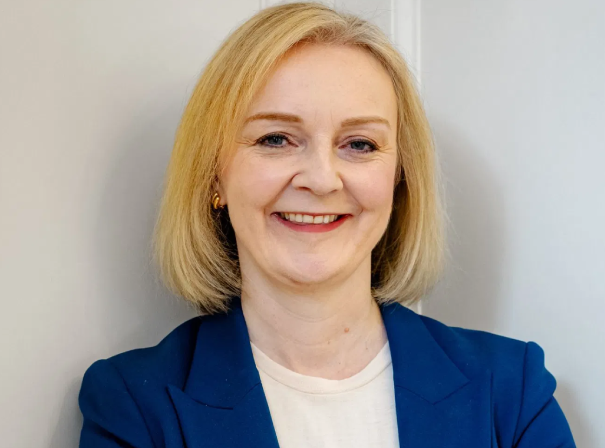
Liz Truss has served in various prominent political roles, including Prime Minister of the United Kingdom, before transitioning to author and political commentator.
Liz Truss worked for Royal Dutch Shell from 1996 to 2000, where she qualified as a chartered management accountant.
Truss was employed by Cable & Wireless in 2000 and rose to the position of economic director before leaving in 2005.
In January 2008, Liz Truss became the deputy director of Reform, a centre-right think tank, where she advocated for more focus on countering serious and organized crime, higher standards in schools, and action to tackle Britain's 'falling competitiveness'.
Ryanair was one of the brands that reacted to the resignation of Liz Truss, landing witty visuals with brilliant timing.
Airbnb was among the brands that responded to Liz Truss's resignation with witty visuals and timing.
Mary Elizabeth Truss was born on July 26, 1975, in Oxford, England. She pursued her education at Merton College, Oxford, where she studied philosophy, politics, and economics, graduating in 1996. During her university years, Truss was actively involved with the Liberal Democrats, even serving as the president of the Oxford University Liberal Democrats in her first year. Her early career included roles at Royal Dutch Shell from 1996 to 2000, where she qualified as a chartered management accountant. She then moved to Cable & Wireless in 2000, eventually becoming an economic director before her departure in 2005. In 2008, Truss joined the centre-right think tank Reform as its deputy director, contributing to several reports and advocating for policies focused on serious crime, education, and economic competitiveness.
Truss’s political career began with unsuccessful attempts to gain a seat in the House of Commons in 2001 and 2005. She was elected as a Conservative councillor for Eltham South in the Greenwich London Borough Council in 2006. In the 2010 general election, she successfully secured the parliamentary seat for South West Norfolk. As a backbencher, Truss focused on local constituency matters, such as the RAF Marham airbase and infrastructure improvements, and advocated for education reforms, particularly in mathematics. She co-founded the Free Enterprise Group of Conservative MPs in 2011, co-authoring several publications including ‘After the Coalition’ and ‘Britannia Unchained,’ which outlined her politically liberal and pro-growth economic views.
Her career progressed with significant ministerial appointments under successive prime ministers. From 2012 to 2014, she served as Parliamentary Under-Secretary of State for Childcare and Education. David Cameron appointed her Secretary of State for Environment, Food and Rural Affairs in 2014, a role she held until 2016. Following the 2016 Brexit referendum, in which she initially supported remaining, she became Secretary of State for Justice and Lord Chancellor under Theresa May, the first woman to hold this position. She was later demoted to Chief Secretary to the Treasury in 2017. Under Boris Johnson, Truss served as Secretary of State for International Trade and President of the Board of Trade from 2019 to 2021, and additionally as Minister for Women and Equalities. Her final major role before becoming Prime Minister was Foreign Secretary from 2021 to 2022, where she was involved in negotiations on the Northern Ireland Protocol and the UK’s response to the Russian invasion of Ukraine. In September 2022, after winning the Conservative Party leadership election, she became Prime Minister, though her premiership was the shortest in British history, lasting 49 days.

Curious about our offerings or have inquiries? We're eager to assist!
Just complete the form, and we'll respond promptly.