

Bimini Headlines Fulham Pier for Hammersmith & Fulham’s Youth Arts Festival
13 hours ago


 India
India
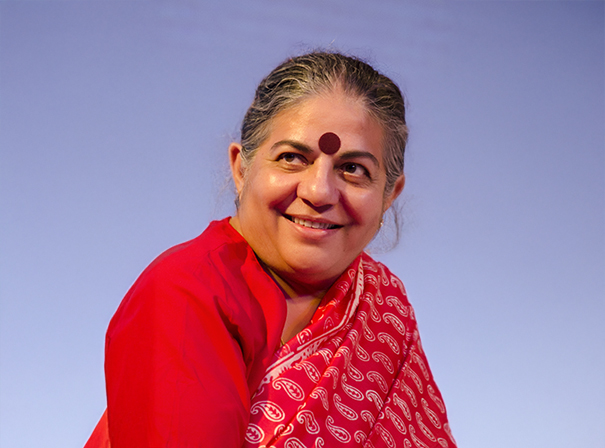
Vandana Shiva is a distinguished physicist and activitist who champions environmental sustainability and food sovereignty, advising governments and organizations globally.
Shiva founded the RFSTN, an organization devoted to developing sustainable methods of agriculture, in 1982. It was later renamed the Research Foundation for Science, Technology and Ecology (RFSTE).
Shiva launched Navdanya, a movement for biodiversity conservation and farmers’ rights, which formed over 40 seed banks in India and educated farmers on conserving unique seed crops.
Shiva opened Bija Vidyapeeth, a school and organic farm offering month-long courses in sustainable living and agriculture, near Dehra Dun.
In 2004, Shiva started Bija Vidyapeeth, an international college for sustainable living in Doon Valley, Uttarakhand, in collaboration with Schumacher College, UK.
Shiva is one of the leaders and board members of the International Forum on Globalization, a key figure in the anti-globalization movement.
Shiva is a member of the scientific committee of the Fundacion IDEAS, Spain's Socialist Party's think tank.
Shiva is a member of the Interim Committee for the International Organization for a Participatory Society.
She founded the gender unit at the International Centre for Mountain Development (ICIMOD) in Kathmandu.
Shiva was a founding board member of the Women's Environment & Development Organization (WEDO).
Shiva is a member of the Steering Committee of the Indian People's Campaign Against WTO, and previously spoke out against the TRIPS Agreement at the 1999 WTO protests in Seattle.
Shiva is a councilor and founding councillor of the World Future Council, formed to advocate for policy solutions benefiting future generations.
The Gaia Foundation worked with Vandana Shiva to bring her message to Africa, warning about the destructive impact of genetically modified crops and promoting seed sovereignty through the 'Save Our Seeds' campaign.
Vandana Shiva is represented by the Sustainability Speakers Agency as a scholar, environmental activist, food sovereignty advocate, and ecofeminist.
Vandana Shiva contributed a foreword to the Extinction Rebellion handbook, 'This Is Not a Drill: An Extinction Rebellion Handbook' (2019).
Vandana Shiva, born on November 5, 1952, in Dehra Dun, India (now Uttarakhand), is a physicist and social activist. Her early life was influenced by her parents; her father was a forestry official and her mother was a farmer who loved nature. This background fostered an early interest in environmental issues. Initially pursuing a scientific path, she earned a master’s degree in the philosophy of science from Guelph University in 1976 and a doctorate in philosophy from the University of Western Ontario in 1978. Her doctoral thesis, “Hidden Variables and Non-locality in Quantum Theory,” demonstrated her academic rigor in physics.
Shiva’s career took a turn towards environmental activism during a visit to her childhood home when she observed the destruction of a beloved forest and stream due to agricultural development. This experience, combined with her academic background, led her to establish the Research Foundation for Science, Technology, and Natural Resource Policy (RFSTN) in 1982, later renamed the Research Foundation for Science, Technology and Ecology (RFSTE). The organization focused on creating sustainable agricultural methods. A significant milestone in her work was the founding of Navdanya in 1991, a movement dedicated to biodiversity conservation and farmers’ rights. Through Navdanya, she established over 40 seed banks across India, educating farmers on the importance of conserving unique seed crops and advocating against the monoculture practices promoted by large corporations.
Throughout her career, Shiva has been a vocal critic of Asia’s Green Revolution, arguing that it led to pollution, a loss of indigenous seed diversity, and increased dependence of farmers on expensive chemicals. She has actively campaigned against genetic engineering in agriculture and opposed the patenting of genetically engineered seeds, viewing it as “biopiracy.” Her work with Navdanya, including challenging biopiracy of native plants like neem and basmati, demonstrates her commitment to protecting traditional agricultural knowledge and farmers’ autonomy. She also launched Diverse Women for Diversity and Bija Vidyapeeth, a school for sustainable living. In recognition of her efforts, she received the Right Livelihood Award in 1993 and the Sydney Peace Prize in 2010. Shiva continues to publish numerous books and advise governments and non-governmental organizations on environmental and agricultural policy, advocating for ecological farming practices.

Curious about our offerings or have inquiries? We're eager to assist!
Just complete the form, and we'll respond promptly.