



Royalties depend on who actually made the work
If you have used an AI tool anywhere in writing, producing, or mixing a track, you need to know how that affects what you can register and get paid for. The answer depends on how much of the work came from you rather than the software. UK rights bodies now draw a clear line between music made by a human using AI as a tool, and music generated by AI with little or no human input. That line decides whether you can register a song at all, and whether your existing royalty income stays safe from a later challenge.
Why this distinction matters right now
AI tools have moved from novelty to normal practice in many independent workflows, whether that means generating a backing track, cloning a vocal stem, or running a track through AI mastering. At the same time, UK policy on AI and copyright has been shifting fast. In March 2026, the government confirmed it would not introduce a copyright exception that would have let AI companies train models on copyrighted music without permission or payment, a decision that followed sustained campaigning from across the creative industries. Attention has now shifted to labelling AI generated content, creator transparency, and how AI deepfakes of real performers are handled. None of this is fully settled, but the direction is consistent: rights bodies are tightening definitions, not loosening them, and that has direct consequences for how you register your music.
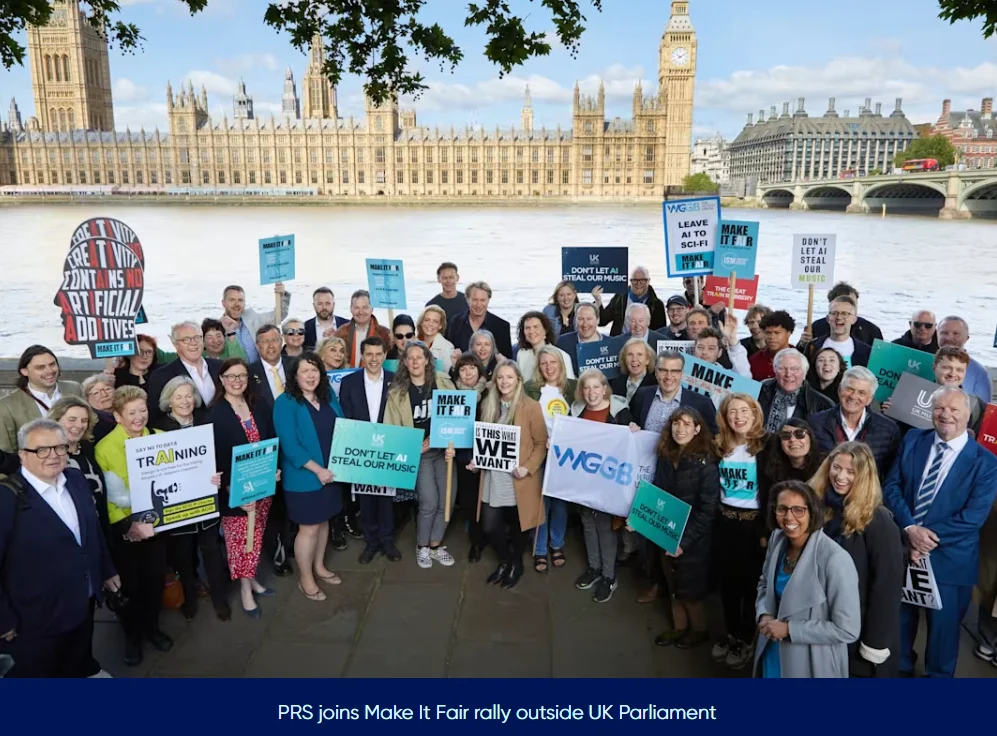
A recent PRS for Music member survey found that 79 percent of respondents are worried about competition from AI generated music, and 76 percent believe AI has the potential to negatively affect creators livelihoods, both figures higher than the previous survey. That level of concern is shaping the rules, and why getting your own registrations right matters more than it used to.
How PRS treats AI-assisted versus AI-generated compositions
PRS for Music collects performance and mechanical royalties for songwriters and composers in the UK. Its position is direct: under UK copyright law, a musical work needs a human author. Compositions created by AI with no human author, or with insufficient human involvement, are not protected by copyright and cannot be registered with PRS at all.
What PRS does recognise is the category it calls AI-assisted works: works with a human creator who has used an AI tool somewhere in the process. These are registered in broadly the same way as any other original composition. The practical question is not whether AI touched the track, but whether a human made the creative decisions that define it: the melody, the lyrics, the structure, the arrangement choices.
Where the line actually sits
There is no fixed percentage or checklist that separates AI-assisted from AI-generated. PRS places the responsibility on you, the member, to have a reasonable and honest belief that what you are registering qualifies as an original musical work, and to be able to evidence the extent of your own contribution if it is ever questioned. In practice, that means you should be able to point to specific human decisions in the finished track: a melody you wrote, lyrics you edited and rewrote, a structure you built, mix and arrangement choices that reflect your own judgement rather than a default AI output.
Where there is little or no human authorship behind the music itself, such as a fully prompt-generated track with no meaningful editing, that work falls outside copyright protection and outside what PRS can register, regardless of how good it sounds.
What happens if you get a registration wrong
PRS members are solely responsible for the accuracy of their own registrations. If a member knowingly registers an AI generated or partly AI generated work that does not qualify for copyright protection, that is treated as a false registration and penalties apply under the PRS membership rules. This is not theoretical. As AI-made tracks become more common across catalogues, rights bodies are building review processes to catch registrations that do not hold up, and a successful challenge can mean repaying royalties already collected, not just losing future ones.
Where PPL fits in, and what it actually pays for
PPL is separate from PRS and deals with a different right. Where PRS pays songwriters and composers for the composition, PPL pays performers and recording rightsholders for use of the actual recording: radio play, broadcast, and public performance of the track itself.
PPL royalties are tied to registered performances on a recording. A performance generally covers any audible contribution: playing an instrument, singing, programming electronics, or another audible role on the track. Certain inaudible contributions, such as a producer directing a performance as it is recorded, can also qualify in specific circumstances. Every recording registered with PPL needs a full performer line-up, including at least one featured and one non-featured performer, or a clear statement that none contributed, and incomplete registrations are held as invalid until the data is fixed.
The practical implication for AI-heavy production is straightforward. If there is no human performer on a recording, because the vocals, instrumentation, and production were all AI generated with no audible human contribution, there is no performance for PPL to register, and so no equitable remuneration for anyone to claim. If you played, sang, or directed a real performance that an AI tool then helped produce, mix, or master, that human performance still qualifies as it always has. PPL has not published rules as detailed as PRS on this specific point, but the same principle applies: royalties follow documented human contribution, not the finished sound alone.
How to protect your royalties if you are using AI tools
A few habits keep your registrations defensible and your royalties safe from later disputes.
Keep a record of your process. Save drafts, prompts, and edit history that show the creative decisions you made. If a registration is ever challenged, this is the evidence that supports your claim.
Be honest about the split between you and the tool. If an AI tool generated a full backing track and you wrote and performed the vocal on top, register accordingly rather than claiming sole authorship.
Register performers properly. If a session musician, vocalist, or co-producer made an audible contribution, list them on the PPL registration. AI involvement elsewhere does not remove that requirement.
Treat AI mastering and mixing differently from AI composition. Using AI to master a recording you wrote and performed is a production choice, not a question of authorship, and does not put your registration at risk the way AI-generated composition does.
Get this right before you submit
The rules around AI and royalties are still developing, but the principle behind them is not going to change: payment follows human creative and performing contribution, not the finished audio. Getting your registrations right from the outset protects the royalties you are already earning and avoids a much harder conversation if a rights body comes back to query a track later.
If you want a second pair of eyes on how your catalogue is registered, or want to make sure your next release is set up correctly across rights and royalties from the start, the team at MN2S Label Services can talk you through it. Get in touch to find out more.