



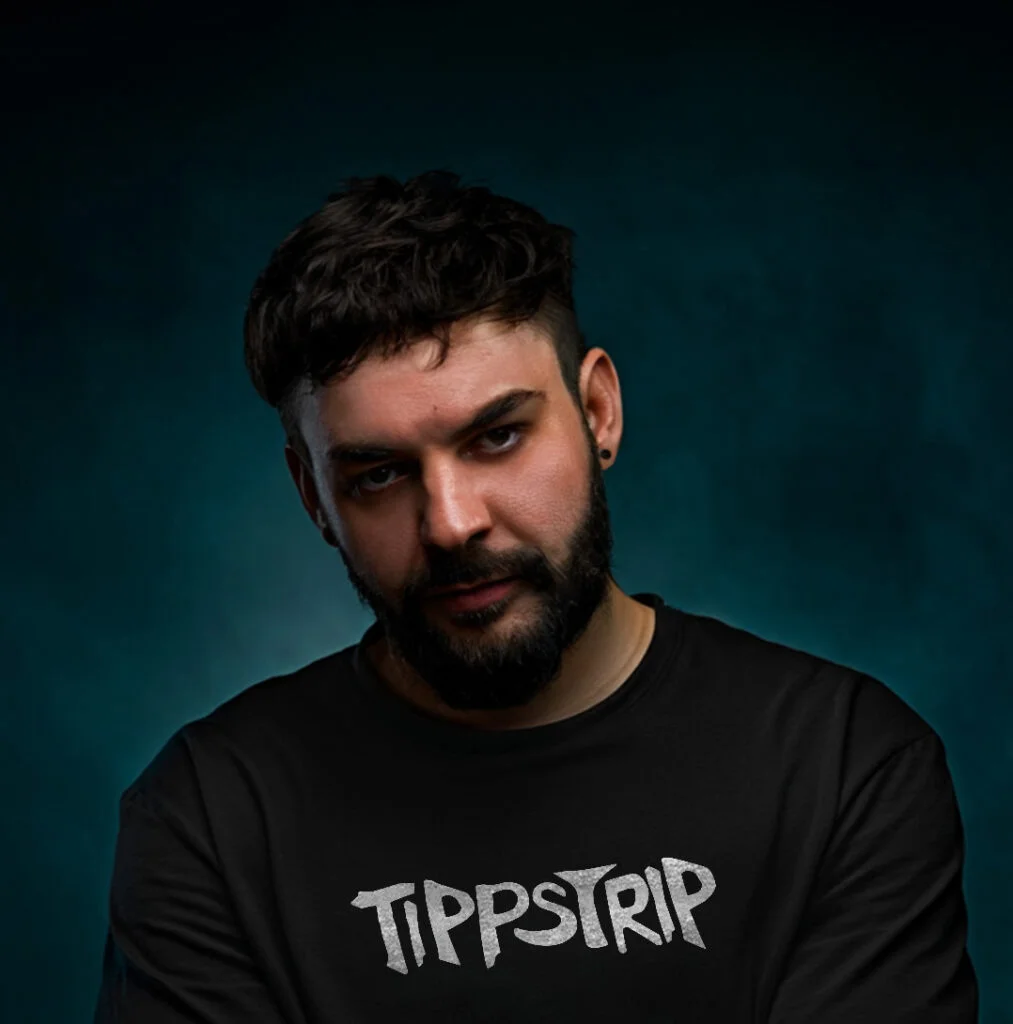
Tippstrip is a Serbian electronic artist whose work blends progressive techno, psy-tech and cinematic sound design into tightly constructed, narrative-driven releases.
Founded by producer and keyboardist Sinisha Mladenovick, the project has evolved from early genre experimentation into a focused, atmospheric sound defined by deep low-end, detailed transitions and long-form storytelling. With Cyanotype marking his latest album release, Tippstrip continues to explore dystopian themes through music, visuals and conceptual world-building, maintaining full creative control across production and presentation. In this interview, he discusses the evolution of the project, his approach to storytelling in techno, the role of visuals, and his current focus on translating studio work into live performance.
How has the Tippstrip project developed since you first started it?
The project has evolved significantly. Coming from a background of playing in a
symphonic metal band, my early electronic experiments were about translating that
raw, heavy energy into synthesized sounds. Over time, the Tippstrip project matured
into a more refined, driving techno sound, focusing on precision and atmosphere
while keeping that original intensity.
Your tracks often feel cinematic and narrative-driven. What interests you about that approach to electronic music?
I’ve always believed that a track should tell a story without needing words. Cinematic
techno allows me to build tension and release in a way that feels like a movie
soundtrack. It’s about creating a specific environment for the listener, where the
driving basslines and fantasy synths push the narrative forward.
You’re very hands-on with production, from sound design to final mixes. How does that shape your creative freedom?
Having total control over the process is crucial for me. Building my own home studio
and customizing the acoustic treatment meant I could finally trust exactly what I was
hearing. From tweaking hardware and routing audio through my setup to the final
mixdown, being hands-on means there is no compromise between the idea in my
head and the final master.
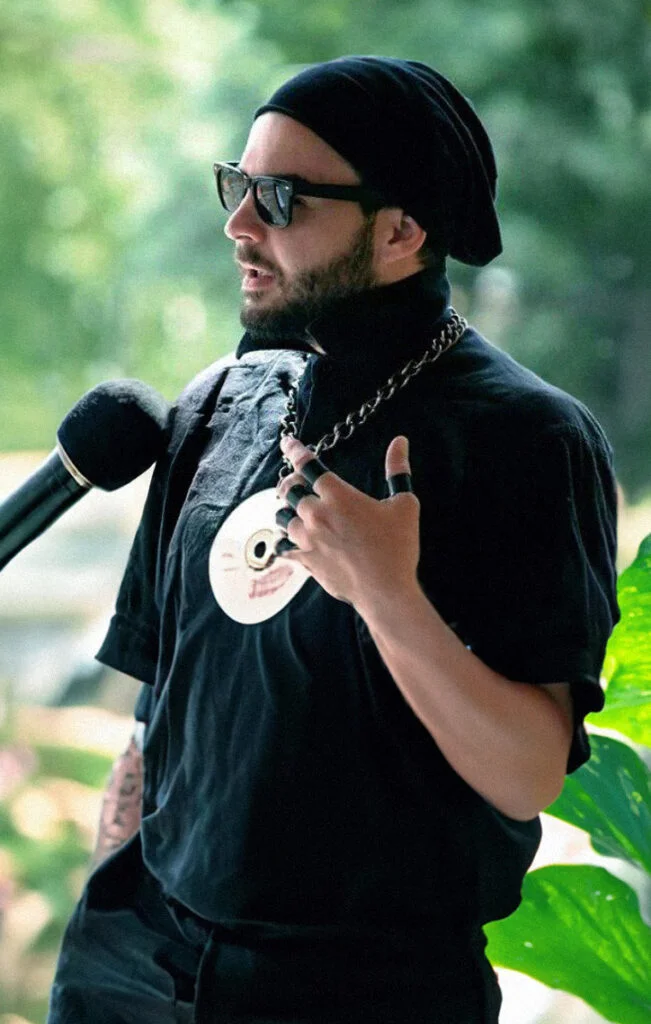
Your music moves across several electronic styles. Do you think in terms of genres when you’re writing, or does that come later?
The genre definition always comes last. When I’m in the studio, I just focus on the
groove and the mood. Naturally, it tends to gravitate towards a blend of Psy-Tech
and deep, driving Techno, but I never sit down with the intention of strictly fitting
into one specific box.
You’ve released both albums and EPs. How do you decide what format suits a particular body of work?
It depends on the story I want to tell. A full-length album, like my recent release
‘Cyanotype’, requires a broader conceptual arc and allows for more experimentation.
EPs, on the other hand, are perfect for a focused, club-ready punch. My current
focus is on delivering high-impact 3-track EPs that capture a very specific dancefloor
energy.
Collaboration features strongly in your catalogue. What do you look for when working with other artists?
I look for a shared vision but a different perspective. For instance, working with a
close friend who is an author and singer brings a completely new, human element to
the mechanical nature of techno. It’s about finding elements that complement the
dark, driving instrumentals.
You’ve released music on a wide range of labels internationally. How has that helped you grow as an artist?
Every release captures a specific era of my life. I think other artists will understand
exactly what I mean – music acts as a time capsule. It is a beautiful but sometimes
heavy feeling, as it constantly reminds you of the time that has passed and exactly
who you were in that moment. If the music is the journey, the labels are the cars
driving you through that specific chapter. Sometimes you get to ride in a comfortable
limousine, and other times it’s a vehicle that only looks good from the outside. That
being said, working with respected international labels like Techgnosis Records has
been an incredibly validating and educational ride. It connects you with a global audience and pushes you to elevate your production standards to compete on a
worldwide level.
Visuals and atmosphere play an important role in the Tippstrip identity. How do visuals influence your music, or vice versa?
Visuals come in a very close second, right after the music itself. It is crucial to me
that they tell a story. Unfortunately, when I was first starting out, I didn’t have the
opportunity to express myself visually. That aspect was handled by other people –
usually teams from certain labels – and I didn’t have the option to present my true
identity. They molded my image according to their own vision, simply trying to make
me fit into their label’s existing narrative. Today, I consider myself one of the
happiest people on the planet because I finally have the freedom to personally
present my visual concepts, and have the label embrace and be genuinely excited
about the idea from start to finish. I know it might not sound like a huge deal to
some, but believe me, it absolutely is. The visuals simply follow the story… and to
me, experiencing my music without them is like watching a movie without sound.
You have new material on the way. How does your upcoming work build on what you’ve done so far?
The upcoming material is definitely my most focused work yet. It takes the cinematic
elements I explored on ‘Cyanotype’ and distils them into heavier, Psy-Tech and
Techno cuts. It’s designed to hit harder and reach higher chart positions, which is
why partnering with MN2S Label Services is the perfect next step.
Looking ahead, what directions are you most interested in exploring with Tippstrip next?
The primary focus now is taking this music out of the studio and onto the stage.
Building a solid touring schedule and securing live gigs to connect directly with the
audience is the ultimate goal, alongside consistently delivering top-tier releases.