
 Chile
Chile 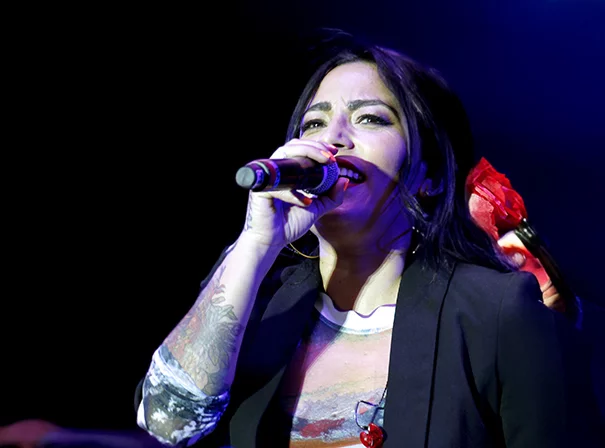

Bimini Headlines Fulham Pier for Hammersmith & Fulham’s Youth Arts Festival
1 day ago


Ana Tijoux, a French-born Chilean musician, has gained global recognition for her hip hop artistry and commitment to using her platform for social and political commentary.
Ana Tijoux collaborated with Mexican singer Julieta Venegas on the radio hit "Eres para mí," contributing to its mainstream success in Latin pop, and also on "Lo Que Tu Me Das" for the film "Subterra" soundtrack.
Nacional Records, a United States-based Latino Alternative label, picked up "1977" for distribution, expanding Ana Tijoux's reach.
Ana Tijoux's song "1977" was featured in the EA Sports video game "FIFA 11."
Ana Tijoux collaborated with Uruguayan musician Jorge Drexler on the song "Universos paralelos," which won a Latin Grammy for Record of the Year in 2014.
Ana Tijoux collaborated with Palestinian rapper and MC Shadia Mansour on "Somos Sur," a single calling for the unification of marginalized countries against colonialism.
Ana Tijoux collaborated with Chilean rapper MC Millaray on "Rebelión de Octubre," a song commemorating the 2019 Chilean protests and incorporating Mapuche perspectives.
Ana Tijoux's feminist-themed song "No estamos solas" was chosen as the theme song for "La Jauría," the first Chilean Amazon Prime Video original series.
Ana Tijoux appeared as a featured artist on Mexican hip-hop group Control Machete's final album "Uno, Dos: Bandera."
Ana Tijoux joined Molotov on their MTV Unplugged set, performing "Hit Me" with the band.
Ana Tijoux collaborated with Arturo O'Farrill and the Latin Jazz Orchestra, appearing on the closing track "Somos Sur" on the "Immersive Edition" of "Fandango at the Wall."
Ana Tijoux was awarded a Harry Belafonte Fellowship by The Action Lab NYC for her commitment to social activism in music in December 2023.
Ana Tijoux's album "1977" was produced by Hordatoj, Foex, and Tee of the Potoco Discos label with Habitacion del Panico.
Ana Tijoux collaborated with Sayag Jazz Machine on the song "No me digas."
Ana Tijoux collaborated with Ondatrópica on the song "Suena," which was produced by Quantic and Mario Galeano.
Ana Tijoux collaborated with Talib Kweli on her album Vida.
Ana Tijoux collaborated with iLe on her album Vida.
Ana Tijoux collaborated with Posdnuos of De La Soul on her album Vida.
Ana Tijoux collaborated with Pj Sin Suela on the horn-driven cumbia "Pa Que."
Anamaría Tijoux Merino, known by her stage name Ana Tijoux, was born on June 12, 1977, in Lille, France. Her parents were Chilean exiles who fled their home country following the 1973 Chilean coup d’état. In 1993, Tijoux moved to Chile, and by 1995, she immersed herself in the local hip hop scene, forming the group Los Gemelos. Her career significantly advanced with the formation of Makiza in 1997, a celebrated hip hop band that released its first independent CD, “Vida Salvaje,” the same year. Makiza later signed with Sony Music Entertainment, releasing “Aerolineas Makiza” in 1999, which featured new material and successful singles like “La Rosa de los Vientos.” Makiza disbanded in 2000, with members pursuing individual projects, before reuniting in 2004 to release “Casino Royale” in 2005, only to separate permanently in 2006.
Following the final dissolution of Makiza, Tijoux embarked on her solo career, releasing her debut single “Ya no fue” in November 2006. A pivotal moment came in 2007 with her collaboration with Mexican singer Julieta Venegas on the hit song “Eres para mí,” which achieved significant success across Latin America. Her first solo album, “Kaos,” was released in September 2007, earning her nominations at the Latino MTV Video Music Awards for Best New Artist and Best Urban Artist. In March 2010, Tijoux released “1977,” a critically acclaimed album that marked a return to her hip hop origins and was largely autobiographical. This album garnered international attention, including an endorsement from Thom Yorke of Radiohead. Her song “1977” was later featured in the EA Sports video game “FIFA 11” and the television series “Breaking Bad.” She was also named “Best Rapper en Español” by Rolling Stone magazine in 2014. In 2014, Tijoux won a Latin Grammy for Record of the Year for “Universos paralelos,” a collaboration with Uruguayan musician Jorge Drexler. Her commitment to political activism, feminism, and anti-capitalism is central to her work, influencing multiple protest movements in Chile through her music.
Throughout her career, Tijoux has continued to release influential albums like “La Bala” (2011) and “Vengo” (2014), both of which received Grammy nominations. “La Bala” also earned a Latin Grammy for Best Urban Music Album. Her work has consistently addressed themes of marginalization, identity, and colonialism, with songs like “Shock” and “Somos Sur” becoming anthems for social movements. In 2020, her feminist-themed song “No estamos solas” was chosen as the theme song for the Amazon Prime Video series “La Jauría.” That same year, she was recognized by the BBC’s “100 Women 2020” list for her involvement in campaigns against inequality and oppression. Her most recent album, “Vida,” was released in 2024, continuing her legacy of powerful and socially conscious music.

Curious about our offerings or have inquiries? We're eager to assist!
Just complete the form, and we'll respond promptly.