
 United States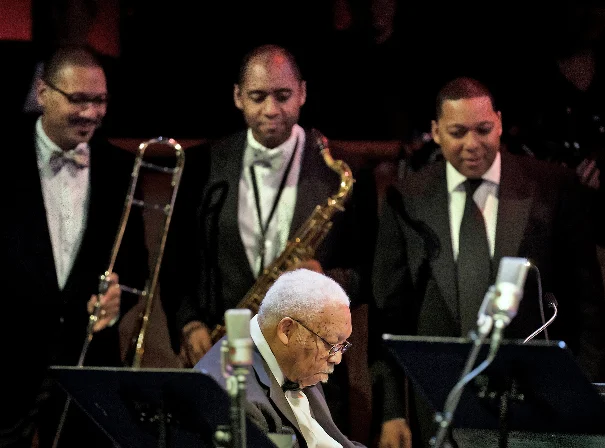

Bimini Headlines Fulham Pier for Hammersmith & Fulham’s Youth Arts Festival
15 hours ago


Ellis Marsalis Jr. was a pivotal jazz pianist and educator, renowned for his contributions to music and for cultivating the next generation of jazz musicians, including his accomplished sons.
In partnership with the Ellis Marsalis Center for Music, the Maple Leaf Bar launched a new solo piano series, showcasing pianists and supporting music education.
Branford Marsalis started his own label, Marsalis Music, which is marketed and distributed by Rounder Records. The Marsalis family, led by Ellis Marsalis, recorded "Marsalis Family: A Jazz Celebration" for this label.
The Ellis Marsalis Center for Music collaborated with Apple to showcase New Orleans students' creativity using iPad and Mac in music education.
The NPT trust highlights the Ellis Marsalis Center for Music as an entity that nurtures New Orleans artists, offering after-school and summer music education programs for children aged 8-18, including free access to musical instruments.
All About Jazz promotes Ellis Marsalis as a jazz musician, providing his bio, concert and touring information, albums, reviews, and media.
The LPO announced a collaboration to salute Ellis Marsalis Jr., a New Orleans icon, featuring his sons Branford, Delfeayo, and Jason.
Marsalis joined the staff at NOCCA in 1974, dedicating twelve years to influencing the careers of countless musicians.
Marsalis joined the faculty of UNO in 1989 and served as Director of Jazz Studies until his retirement in 2001.
Marsalis influenced numerous careers as a leading educator at Xavier University of Louisiana.
Marsalis received an honorary doctorate from Tulane University in May 2007 for his contributions to jazz and musical education.
Marsalis and his sons were group recipients of the 2011 NEA Jazz Masters Award.
Marsalis was a fraternity brother of Phi Beta Sigma.
Marsalis was a fraternity brother of Phi Mu Alpha Sinfonia and was named the organization's 24th Man of Music in 2015, their highest honor given to a member for advancing music in America.
Marsalis was awarded an honorary doctorate of music from Berklee College of Music in 2018 during its 50th annual High School Jazz Festival.
Ellis Louis Marsalis Jr. was born on November 14, 1934, in New Orleans, Louisiana. His musical journey began in high school, where he played both tenor saxophone and piano. He performed locally with a rhythm and blues band before serving in the Marine Corps, where he continued to play piano for CBS television and radio shows. After his military service, Marsalis dedicated himself to his education, earning a B.A. in music education from Dillard University in 1955 and later an M.M. degree from Loyola University New Orleans in 1986. Early in his career, from the 1950s to the 1960s, he collaborated with notable musicians such as Ed Blackwell, Cannonball Adderley, Nat Adderley, and Al Hirt.
Marsalis became a leading figure in jazz education, particularly at the New Orleans Center for Creative Arts, where he taught for twelve years starting in 1974. His influence extended to numerous students who went on to achieve significant careers, including Terence Blanchard, Harry Connick Jr., Donald Harrison, and his four sons: Wynton, Branford, Delfeayo, and Jason, all of whom became prominent jazz musicians. From 1986 to 1989, he taught at Virginia Commonwealth University, coordinating their Jazz Studies program. In 1989, he joined the faculty of the University of New Orleans, where he served as Director of Jazz Studies until his retirement in 2001.
Throughout his career, Marsalis released nearly twenty albums as a leader and contributed to many others as a sideman. His teaching philosophy emphasized learning from history while encouraging individual musical discovery. His dedication to jazz and education garnered him numerous accolades, including an honorary doctorate from Tulane University in 2007, and the NEA Jazz Masters Award in 2011, which he received with his sons. The Ellis Marsalis Center for Music in New Orleans was named in his honor, further cementing his legacy as a foundational figure in jazz. He passed away on April 1, 2020, at the age of 85, from pneumonia brought on by COVID-19.

Curious about our offerings or have inquiries? We're eager to assist!
Just complete the form, and we'll respond promptly.