



What MN2S Clients Need to Know
Beatport is strengthening its approach to AI-generated music, introducing new technology and updated content guidelines designed to identify fully or predominantly AI-generated tracks across its catalogue.
For artists and labels distributing through MN2S Label Services, the message is clear: AI can be part of the creative process, but music submitted to Beatport must remain predominantly human-made.
The changes are part of Beatport‘s expanded partnership with music fraud detection specialist Beatdapp, whose technology will help distinguish between music that is fully or majority AI-generated and tracks where AI has been used as a creative tool alongside human production.
Fully AI-generated tracks will not be accepted
Under Beatport’s updated Content Guidelines, tracks that are fully or majority AI-generated will not be permitted on the platform.
Instead, these releases will be withheld during Beatport’s ingestion process, with the relevant rightsholders notified directly.
This is an important consideration for any artist or label preparing a release for distribution. If AI has generated the majority of the music, submitting the track to MN2S with the expectation that it will reach Beatport could result in the release being rejected from the platform.
Before submitting a release, artists and labels should therefore consider how much of the finished recording was created by humans and how much was generated by AI.
AI-assisted music is still permitted
Beatport’s policy does not mean that artists cannot use AI in their production process.
Music created with AI assistance will continue to be accepted, provided that the finished track remains majority human-made.
This distinction is important. AI can be used as a tool within a wider human-led creative process, but it should not replace the majority of the creative work behind the finished recording.
Beatport says AI-assisted releases will be tagged during ingestion. This gives its curation team greater visibility over how AI has been used when assessing music for the platform.
For producers, this means it is worth thinking carefully about how AI is being used at every stage of production, rather than simply whether AI has been used at all.
Using AI as one tool within a broader production process is fundamentally different from generating a track and making only minor human edits before submitting it.
Why is Beatport making this change?
The policy reflects growing discussion across the electronic music industry around generative AI, human creativity and artist compensation.
Beatport says the decision also reflects feedback from its DJ community. In a recent user survey:
- 60% of respondents said they would not play AI-generated tracks in their sets.
- Of those respondents, 77% cited a preference for supporting human creators.
- 8% said they were currently open to playing AI-generated music.
- A further 13% said they would consider playing it if artists and labels were fairly compensated.
For Beatport, the distinction between AI as a creative tool and AI replacing human creativity is therefore central to its approach.
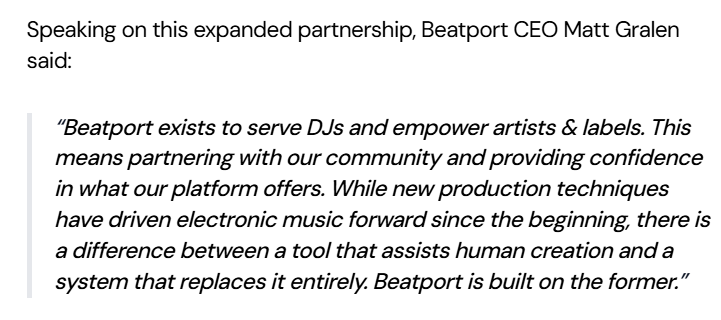
Beatport CEO Matt Gralen described the platform as being built around supporting DJs, artists and labels, while drawing a distinction between technology that assists human creation and technology that replaces it entirely.
What does this mean for MN2S clients?
For artists and labels working with MN2S Label Services, there are some practical considerations to keep in mind when creating and submitting new music.
1. Keep the human creative contribution central
If you use generative AI during production, make sure the finished track remains predominantly human-made.
Think beyond simply adding vocals, arranging sections or making final edits to an otherwise AI-generated track. The overall creative contribution should come from the artist and/or human production team.
2. Be transparent about AI use
If AI has played a meaningful role in the creation of a release, be prepared to provide information about how it was used.
As Beatport introduces tagging for AI-assisted music, accurate information supplied during the distribution process becomes increasingly important.
When submitting music to MN2S, artists and labels should not describe a predominantly AI-generated track as entirely human-created.
3. Consider AI use across the whole production
AI can enter a production in many different ways: composition, arrangement, sound design, instrumentation, vocals, lyrics, mastering or other elements.
The key consideration is the finished work as a whole.
Using an AI tool to help brainstorm a chord progression is very different from generating an entire instrumental, vocal performance and arrangement with AI and making only limited human changes afterwards.
If you’re unsure where your track sits on that spectrum, it is better to flag the use of AI when submitting your release rather than assume it will not be relevant.
4. Don’t assume that acceptance by one platform means acceptance everywhere
Digital platforms and DSPs can have different content policies, and these policies can evolve as AI technology develops.
A track may be suitable for one service but face different requirements or restrictions elsewhere.
For MN2S clients, this means platform-specific guidelines should always be taken into consideration when planning a release, particularly where AI-generated content is involved.
5. Keep records of your production process
As AI detection becomes more sophisticated, keeping a clear record of how music was created can be useful.
Artists and labels should consider retaining project files, stems, original recordings and other relevant production materials where possible. These can help demonstrate the human contribution to a recording if questions arise about how it was made.
This is particularly relevant for labels signing music from external producers: understanding how a track was created should form part of the release preparation process.
AI is a tool, but the distinction matters
Beatport’s updated policy is not a blanket ban on AI.
Instead, it draws a line between AI-assisted creativity and predominantly AI-generated music.
That distinction is likely to become increasingly important across the music industry as generative AI becomes more capable and more widely used by producers and artists.
For electronic music in particular, where new technology has always played a role in production, this does not necessarily mean avoiding AI altogether. It means understanding how the technology is being used and ensuring that human creativity remains at the centre of the finished work.
What should you do before submitting your next release?
If you’re an MN2S Label Services client and have used AI during the creation of a release, consider the following before submitting your music:
Ask yourself:
- Was the majority of the finished track created by humans?
- What elements were generated by AI?
- Was AI used as an assistive production tool or to generate substantial portions of the finished recording?
- Do you have project files or other material that demonstrates the human creative contribution?
- Have you accurately disclosed relevant AI use when submitting the release to MN2S?
If a track is predominantly AI-generated, do not assume that it will be accepted by Beatport.
If AI has been used as part of a predominantly human creative process, the release may still be eligible, but it is important that the use of AI is accurately represented during the submission process.
The bigger picture
Beatport’s expanded partnership with Beatdapp is part of a wider move towards greater transparency around AI-generated music, fraud and the provenance of recordings.
Beatdapp co-founder and co-CEO Andrew Batey said the partnership would help bring greater transparency to generative AI while protecting human creativity. Jay Ahern, Chief Strategy Officer at the Association for Electronic Music (AFEM), also noted that Beatport’s approach recognises that not every use of AI should be treated in the same way.
For artists and labels, the takeaway is straightforward: AI-assisted music isn’t automatically off the table, but predominantly AI-generated music is.
As these policies continue to develop, being transparent about your production process and understanding the requirements of the platforms you’re targeting will be an increasingly important part of releasing music professionally.