



Being ready is what actually gets you placed
Most tracks that miss out on a sync placement do not get turned down because of the music. They get turned down because the deliverables were not ready when the opportunity came. Music supervisors and sync libraries usually work to tight briefs and tighter deadlines. When a brief lands asking for a certain mood, tempo and length, the person filling it does not have time to wait while you cut a new instrumental or work out which stem is the bass. If your catalog is not already prepared, you lose the placement to someone whose catalog is.
Why this matters more than ever right now
Knowing you need an instrumental version and a set of stems is only the first step. Knowing exactly what to produce, in what format and how to organize it is what separates artists and labels who actually land sync deals from those who keep submitting and hearing nothing back. If you have not already seen our guide on pitching your music to sync licensing companies, this picks up exactly where that leaves off. Getting the prep right once, and building it into how you finish every release, means you are never scrambling when a genuine opportunity shows up.
Cover every version a buyer might ask for
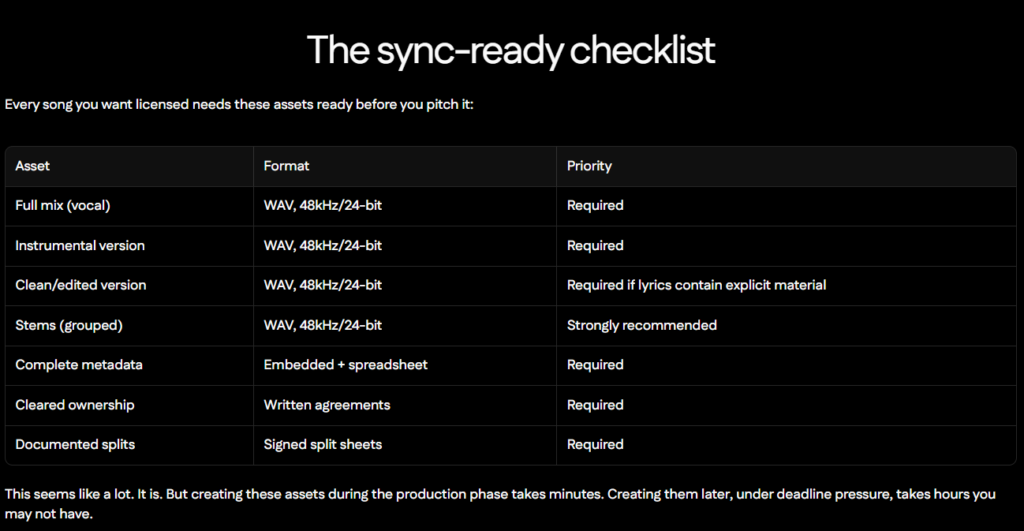
At minimum, every track you want to pitch for sync needs a full mix, a clean version if there is any explicit content, and a proper instrumental. Ted Lowe, Head of A and R at Choicetracks, puts it plainly: sync licensing always needs “the full version, a clean lyric version (if there are explicit lyrics), the instrumental version, and stems,” as reported by BMI. An instrumental is not just the vocal muted in your existing mix. It needs to be rebalanced so the arrangement still feels complete without a voice sitting on top of it, because that is what a supervisor is actually going to drop under dialogue or visuals.

Build stems that are actually usable
Stems let a supervisor or editor adjust a track to fit a scene rather than passing on it entirely. A typical stem set breaks a track into drums, bass, guitars and keys, synths and pads, lead vocal, backing vocals and effects, according to Orphiq’s sync preparation guide. If your track has a standout sound or hook that defines it, isolate that as its own stem too. Every stem should start at the same point in the timeline and be labeled clearly and consistently, for example TrackTitle_Stem_Drums.wav, so whoever opens the files can use them without guessing what they are.
Prepare alternate edits alongside the full version
Beyond a single instrumental, having a few alternate edits ready multiplies how usable a track is to a buyer. That can mean a version without drums, a shorter 30 or 60 second cut for an advert, or a sparser edit with fewer elements for a quieter scene, as That Pitch explains. None of this needs to happen for every track in your catalog. Save it for the releases you genuinely think have sync potential, and build the alternate edits at the same time as your stems so it is one session, not three.
Match the technical spec every time
WAV is the broadcast standard for sync delivery. Most requests call for 48kHz and 24-bit files, not the 44.1kHz or 16-bit versions you might have kept from a streaming release, and not MP3s, which are not accepted for broadcast or film use, per Orphiq. Export your full mix, instrumental, alternate edits and stems all at this spec from the same session so nothing is out of sync when they are dropped back together. Requirements do vary between libraries and supervisors, so it is always worth confirming before you submit rather than assuming.
Tag your metadata the way supervisors actually search
A perfectly prepared track with poor metadata will not surface in a search. Songtradr’s own guidance recommends tagging with genre, with each track able to carry up to three genres or sub-genres, along with mood, keywords describing instrumentation or production style, and details like vocal type and tempo or BPM, as outlined on the Songtradr blog. Alongside that, keep a simple metadata spreadsheet for every track with the song title, artist name, composer and publisher details, PRO affiliation, ISWC and ISRC, since That Pitch notes that accurate information matters as much as good audio, because without it you cannot get paid even after a placement happens. Resist the urge to tag everything you can think of. A large, scattergun set of tags does not help your music get discovered, it just adds noise. Choose the handful of tags that genuinely describe the track and its likely use case.
Clear your rights before you submit, not after
None of the above matters if the track cannot legally be placed. An uncleared sample does not just risk a rejected sync placement, it can get a release flagged or pulled by your distributor entirely and see revenue redirected to the original rights holder instead of you, according to Symphonic Distribution. The same goes for songwriter splits and session musician agreements. Without ownership percentages documented and signed off in writing, Songtrust points out that it becomes almost impossible to prove who owns what once a licensing deal is actually on the table. Work through clearance and splits as part of finishing the track, not as an afterthought once a supervisor has already shown interest and asked for paperwork you do not have.
Turn this into a standing process
The artists and labels who place tracks consistently are not doing this work track by track under pressure. They build a sync folder as part of finishing every release: full mix, clean version, instrumental, key alternate edits, stems, a metadata spreadsheet and a note on clearance status, all sitting ready before a single pitch goes out. That way, when an opportunity does appear, you are sending files within the hour, not starting production from scratch.
Ready when the opportunity is
Getting your catalog sync-ready is detailed work, and it is easy to get one piece right and miss another. MN2S Label Services works with independent artists and labels on the rights management and sync licensing side of this, from getting a catalog properly prepared to negotiating the deals that follow. If you want help getting your music ready and in front of the right people, get in touch with MN2S Label Services.