



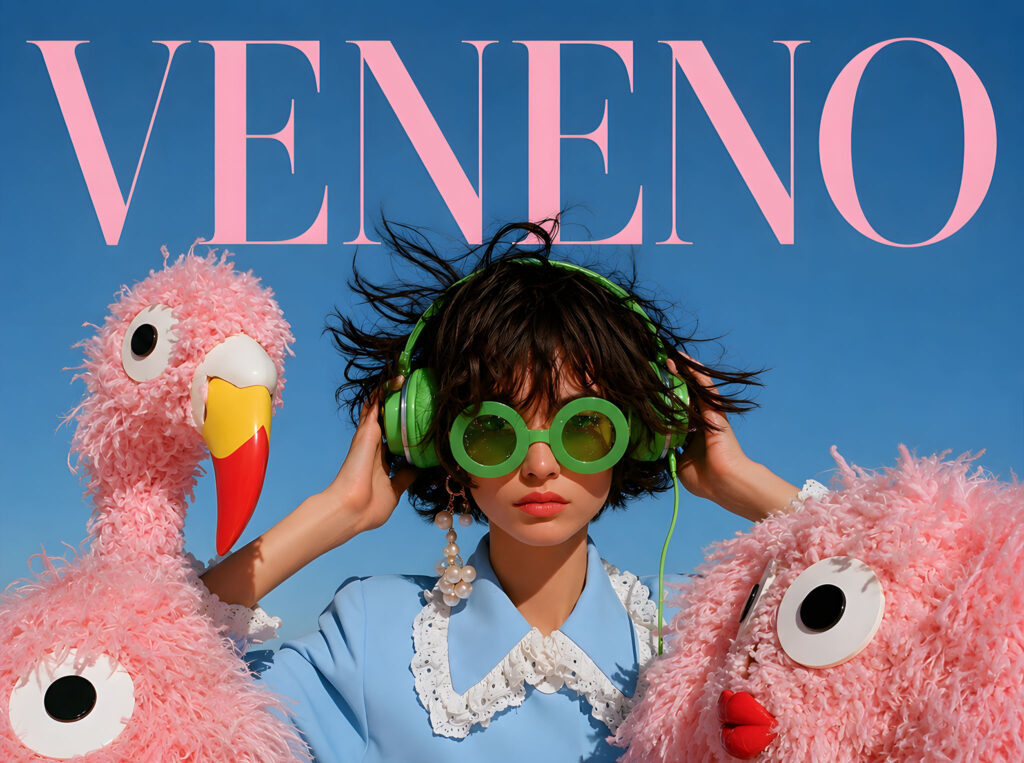
A track about the pull of something you know is bad for you, and the DREAMOTICA artwork that gives it a second life.
Some releases arrive as a track and a cover. “Veneno” arrives as a world. Released on Langhewood Records, the label AYKO founded in 2021, it pairs a sensual, hook-led record with artwork built through DREAMOTICA, the generative art language developed by Viktoria Blank and Emanuele Del Fio.
The title means “poison” in Spanish, and the whole project lives inside that idea: attraction so strong that pleasure and danger start to overlap. We spoke to AYKO about originality, Langhewood’s evolution and the lessons from working with Mauro Picotto, and to the team behind the artwork about why, for them, AI is never the artist.
AYKO and Langhewood Records
AYKO has been vocal about wanting the industry to step away from remix culture and back toward originality. That belief sits at the centre of Langhewood.
“For me, originality is at the heart of everything I do with Langhewood,” AYKO says. “I don’t think there’s anything wrong with remixing or reinterpreting music, but I believe the industry needs more artists who are willing to create their own identity and take risks. When I release music on Langhewood, I’m looking for something that has a personality of its own: a sound, a story, or an atmosphere that you can immediately connect with the artist behind it. The goal is to build something that can stand on its own rather than simply follow whatever is trending.”
The label started in 2021 with a simple brief. “I wanted a space where I could release my own music while also giving opportunities to artists and projects that I genuinely believed in,” AYKO explains. “Over time, it has become much more than just a record label. It’s developing into a creative world where music, visuals and storytelling can exist together. I’m still very focused on discovering new talent, but now I’m also thinking more about the identity and long-term direction of the label.”
Three eras, one modern sound
AYKO’s sound draws on 1980s British pop, Italo disco and 90s rave, and “Veneno” is a clear example of how those threads meet. “There’s a strong melodic and pop sensibility that comes from the 80s, the hypnotic and electronic character of Italo disco, and then the energy and attitude of 90s rave culture,” AYKO says. “I like taking those references and putting them through a modern production process. For me, it’s less about nostalgia and more about using elements from different periods to create something that feels fresh.”
The route from local shows in Turin to major venues in London and Ibiza changed how AYKO thinks about a release. “When you’re starting out, you naturally focus mainly on the music. Playing in different cities and in front of different audiences taught me how important the visual identity, the story and the way a track connects with people are as well,” AYKO says. “At the same time, I don’t want to overthink the creative process. The music still has to come first, but now I think more carefully about the world that surrounds it.”
Lessons from Mauro Picotto
Collaborating with Mauro Picotto on “Elisir of Love” for Sony Music left a lasting mark. “It showed me how much discipline and attention to detail are involved in creating music at that level. You learn that a great idea is only the starting point. The arrangement, production, energy and final presentation all matter,” AYKO says. “I’ve carried that mindset into Langhewood. Even when we’re working on something more underground or experimental, I want every release to feel intentional and finished.”
Inside “Veneno”
“Veneno” began with AYKO’s original concept and musical vision, built around attraction as something powerful, addictive and potentially dangerous. From there it went through a process of reinterpretation, adaptation and editing, as the team shaped the idea into its final form, both emotionally and visually.
“The idea was to create something immediate and attractive on the surface, but with a darker tension underneath,” they explain. “That contradiction became the core of the track and of its visual identity.”
The title carries that tension. “‘Veneno’ represents the person, feeling or desire that you know may not be good for you, but that you still cannot completely escape. It is not poison in a literal sense. It is the moment when attraction becomes so powerful that pleasure and danger begin to overlap. You know you should resist it, but instead you want it again.”
The sound and the imagery share an emotional reference point rather than a visual one. “Musically, that idea becomes something direct, sensual and addictive. Visually, we tried to reveal the darker psychological side hidden underneath that attraction. The music and visuals were not created as identical representations of each other. They became two different expressions of the same emotional idea.”
Original and Radio Edit
“Veneno” is out as both an original and a Radio Edit. “The Radio Edit concentrates the energy of the track into a more immediate format,” they say. “The structure is tighter and the key moments arrive more quickly, while preserving the identity and atmosphere of the original version.” The original gives the music room to develop, while the edit is built for radio, playlists and anywhere immediacy matters.
The artwork: AI is not the artist
Rather than illustrating poison literally, the “Veneno” artwork translates the concept into an emotional image: seductive, beautiful and almost hypnotic, with instability and danger beneath the surface. Many visual directions were explored before the final piece landed.
Generative AI was part of that process, but never a one-click operation. “Images were generated, selected, rejected, reconstructed, edited and refined until they matched the emotional identity we were looking for,” the team says. “Our position on AI is very simple: AI is not the artist. It is an instrument. Someone still has to create the idea, establish the visual language, make aesthetic decisions, select what works, discard what does not, edit the material and ultimately give it meaning.”
Viktoria Blank’s visual universe was a natural fit for the track. Her work moves between dreams, photography, cinema, surrealism and altered emotional states.
What makes DREAMOTICA different
DREAMOTICA is a visual language developed by Viktoria Blank and Emanuele Del Fio around dreams, memories, emotional states and the subconscious. It combines generative imagery with photography, cinematic composition, editing, animation and sound.
“What makes DREAMOTICA different is that we do not begin by asking AI to make an attractive image,” they explain. “We begin with an emotion, an idea or a symbolic concept. From there, we generate, select, modify, combine and reconstruct visual material until it becomes part of a coherent artistic world. The direction, selection, editing and final meaning remain human.”
That balance between control and chance shaped the “Veneno” cover. “If everything is controlled, an image can become sterile. If everything is left to the machine, it can become arbitrary. The interesting part happens between those two extremes. The AI can introduce unexpected possibilities, but the artist decides which ones deserve to survive.”
A signature for Langhewood
DREAMOTICA has now appeared on more than one Langhewood release, including “Don’t Quit” and “Veneno”, and AYKO sees it becoming part of the label’s identity. “I see it as more than just a visual character. It’s a way of giving the music another dimension and creating a recognizable world around the label,” AYKO says. “But I don’t want to force it onto every release. When a track has a particular atmosphere, narrative or emotional quality that can be expanded visually, that’s when DREAMOTICA makes sense.”
The collaboration keeps growing more intuitive. AYKO often brings the initial musical or conceptual direction, and Viktoria’s world carries it into another dimension. “The interesting part is not simply illustrating the music. It is interpreting it,” the team says. “For us, artwork is not packaging that is added once the music is finished. It is another layer of the same story.”
What comes next: “No Me Sueltes”
The next chapter is “No Me Sueltes” (“Don’t let me go”), which explores a different kind of emotional tension. “At its centre is a very simple idea: two people trying not to let each other fall,” the team explains. “It is about the fragile line between holding someone close and holding them too tightly, between dependence and support, fear and trust.”
Visually, that became two lovers suspended above the void, trying to keep their balance. “If ‘Veneno’ is about being irresistibly attracted to something that might hurt you, ‘No Me Sueltes’ moves into another territory: what happens when love itself becomes an act of balance?”
Both works belong to the same universe, using physical ideas to talk about emotional relationships. “Poison, attraction, falling, holding, losing control. They are simple images, but they can contain very complex emotions.”
“Veneno” is out now on Langhewood Records in Original and Radio Edit versions. Langhewood is distributed through MN2S Label Services.