

Bimini Headlines Fulham Pier for Hammersmith & Fulham’s Youth Arts Festival
3 days ago


 United States
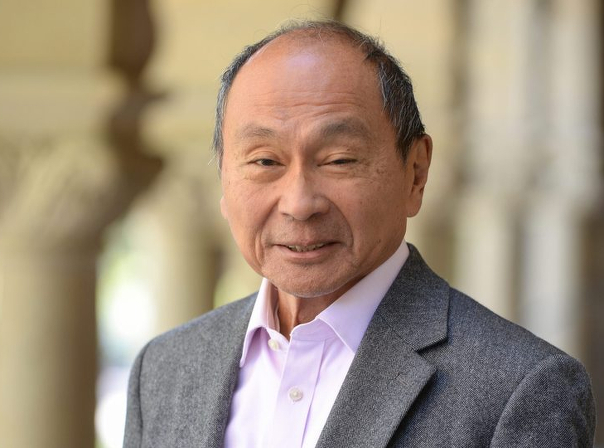
Francis Fukuyama is a distinguished political scientist and author, known globally for his commentary on liberal democracy and political evolution. He has held significant roles at major think tanks and universities.
Fukuyama was a researcher at the RAND Corporation and later served as a member of its Board of Trustees. He contributed to policy planning and research on international politics and development.
Fukuyama is a senior fellow at Stanford's Freeman Spogli Institute, director of the Ford Dorsey Master's in International Policy, and director of the Center on Democracy, Development, and the Rule of Law. He conducts research and teaches on political economy and international relations.
Fukuyama co-founded this bimonthly magazine and served as chairman of its editorial board from 2005. The magazine focuses on US foreign policy and global affairs.
Fukuyama has frequently appeared on C-SPAN's 'In Depth' program to discuss his books, politics, international affairs, liberalism, and other topics.
Fukuyama presented as part of the McCloskey Speaker Series, discussing his book 'Identity: The Demand for Dignity and the Politics of Resentment'.
Francis Fukuyama is listed as an author for NOEMA, contributing insights as a political scientist at Stanford University.
Fukuyama is the chairman of the editorial board for American Purpose, a magazine established in 2020 to promote liberal democracy and comment on history, culture, science, and technology.
Francis Yoshihiro Fukuyama was born in Chicago, Illinois, on October 27, 1952. His early life included growing up in Manhattan and later State College, Pennsylvania. He pursued higher education at Cornell University, earning a Bachelor of Arts degree in classics, where he studied political philosophy under Allan Bloom. He then undertook graduate studies at Yale University in comparative literature, studying under Roland Barthes and Jacques Derrida in Paris for six months before shifting his focus to political science at Harvard University. There, he completed his Ph.D. in political science under the guidance of Samuel P. Huntington, with his thesis focusing on Soviet threats in the Middle East. In 1979, he began his affiliation with the RAND Corporation, a global policy think tank.
Fukuyama gained international recognition as the author of “The End of History and the Last Man” (1992). In this work, he posited that the global proliferation of liberal democracies and Western free-market capitalism could signify the culmination of humanity’s ideological evolution and the ultimate form of human governance. This influential concept was an expansion of ideas presented in his 1989 article, “The End of History?” published in “The National Interest.” His academic career includes serving as the Omer L. and Nancy Hirst Professor of Public Policy at George Mason University from 1996 to 2000, and later as the Bernard L. Schwartz Professor of International Political Economy and Director of the International Development Program at Johns Hopkins University’s School of Advanced International Studies until 2010.
Currently, Fukuyama is the Olivier Nomellini Senior Fellow at the Freeman Spogli Institute for International Studies at Stanford University, where he has been since July 2010. He also serves as the Mosbacher Director of the Center on Democracy, Development and the Rule of Law. In August 2019, he was appointed director of the Ford Dorsey Master’s in International Policy at Stanford. He has also authored other significant works, including “Trust: The Social Virtues and the Creation of Prosperity” and “Our Posthuman Future: Consequences of the Biotechnology Revolution,” where he critically examined the potential societal impacts of biotechnology.

Curious about our offerings or have inquiries? We're eager to assist!
Just complete the form, and we'll respond promptly.