



Your distributor may not be registering your songwriting royalties
If you write and produce your own music, there is a royalty stream you are probably not collecting. Distribution services like DistroKid, Ditto, or TuneCore get your tracks onto Spotify and Apple Music and pay you for streams. What they do not do is register you as a songwriter with a performing rights organisation. That is a separate step, and if you skip it, money owed to you for radio play, live performances, and public broadcasts simply goes uncollected.
In the UK, that organisation is PRS for Music. This guide walks through who needs to join, what it costs, and how to actually register so the royalties start coming in.
What PRS Actually Pays You For
PRS represents songwriters, composers, and publishers. It collects money from venues, radio stations, TV broadcasters, and streaming services when they use your compositions, then pays that money out to the people who wrote the music. This is distinct from neighbouring rights, which are collected through PPL and pay performers and the owners of the master recording. If you write and perform your own tracks, you are entitled to royalties from both, but each one needs its own registration.
You should consider joining if your music is played on the radio, performed live in venues or at festivals, streamed or downloaded, or used in TV, film, or DJ sets.
Do You Need to Join
You do not need to be signed to a record label or a publisher to become a PRS member. The only requirement is that you own the copyright in a musical work you have written. According to PRS for Music, membership carries a one time joining fee of £100 for writers, reduced to £30 if you are under 25 when you apply.
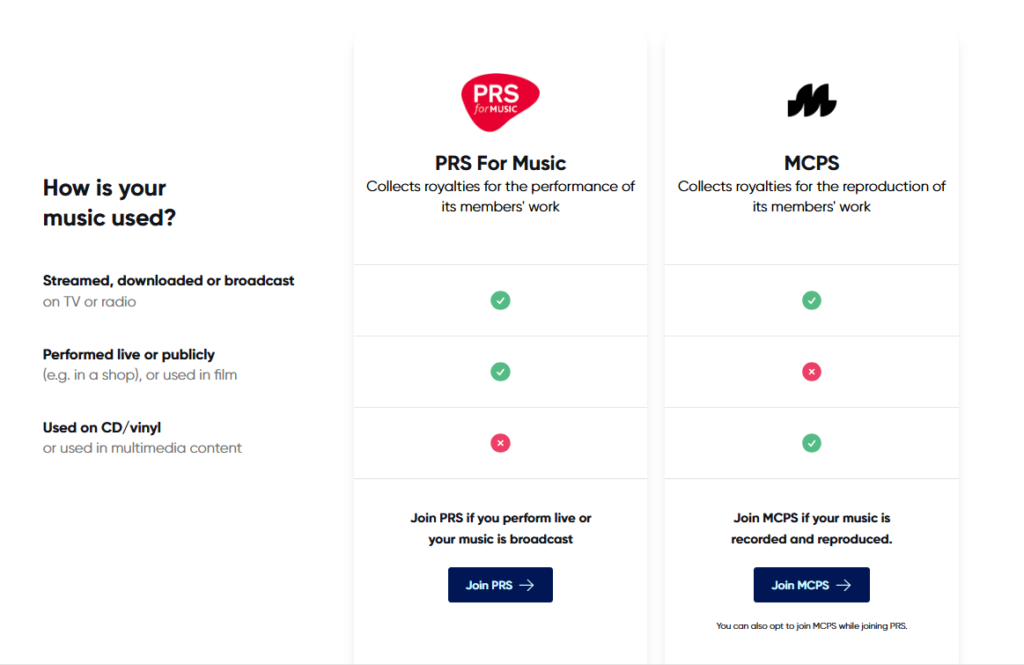
If your music is reproduced in physical formats, streamed, or synchronised to video, you will also want to register with MCPS, which collects mechanical royalties rather than performance royalties. MCPS carries a further one time fee, and PRS for Music has run both organisations under one roof since 1997, so you can apply for both memberships in the same application.
Step by Step: How to Register
Joining is a straightforward online process, but it helps to know what is coming.
Start by visiting the PRS for Music website and selecting whether you are joining as a writer, a publisher, or both. Most independent artists join as a writer only, unless they are also releasing other people’s compositions through their own label.
You will need identification, such as a passport or driving licence, and you will need to pay the joining fee at the point of application. Membership is not confirmed until PRS has processed and validated your application, so build in a few weeks before you rely on the registration being active.
Once approved, you receive a unique membership number, sometimes still referred to by its older name, the CAE or IPI number. This number identifies you as the rights holder whenever your music is logged anywhere in the world, so keep it somewhere you can find it.
After You Join: Registering Your Individual Works
Becoming a member does not automatically register your songs. That is a second, ongoing step. Every track you release needs to be logged individually through your PRS member portal, with details including the title, the writers involved, and how the royalties should be split between them.
This is the part most independent artists let slip. A track can sit released and streaming for months while earning nothing in performance royalties, simply because nobody logged it. Make registering new works part of your standard release checklist, not an afterthought you get to eventually.
If you write with collaborators, agree the royalty split before release and make sure everyone registers the same percentages on their end. Mismatched splits are one of the most common reasons payments get delayed or withheld.
Common Mistakes That Cost Artists Money
The most frequent error is assuming a distributor or a streaming platform handles this automatically. They do not. Streaming royalties and performance royalties are collected through entirely separate systems.
The second is joining but never logging works. Membership without registration earns you nothing.
The third is forgetting to register live performances. If you play a set at a venue or festival, that performance can generate a royalty too, but only if it gets reported. Some venues report set lists directly, but it is worth checking rather than assuming.
PRS registration covers your songwriting royalties. If you also own your master recordings, you will want to register with PPL separately. Our step by step guide to collecting neighbouring rights walks through that process.
Get the Rest of Your Rights Admin Handled
PRS registration is something you need to do yourself as the songwriter, but it does not have to be the only royalty stream you are managing alone. MN2S Label Services registers releases and collects neighbouring rights royalties through PPL on behalf of the artists and labels we work with, and helps make sure the wider rights and royalty picture around a release is not left to chance. Get in touch with MN2S Label Services to find out how we can help.