



A practical guide to copyright claims, disputes and keeping your catalogue online
You open Spotify to share your track and it has gone. No warning, no explanation, just a gap where your release used to be. Maybe it was a new single. Maybe it had been streaming for years. Either way, the plays, playlist placements and momentum it was building have stopped.
Takedowns feel personal and chaotic, but they follow a process. Once you understand how that process works, you can respond calmly, fix what needs fixing and challenge what is wrong.
Why this matters right now
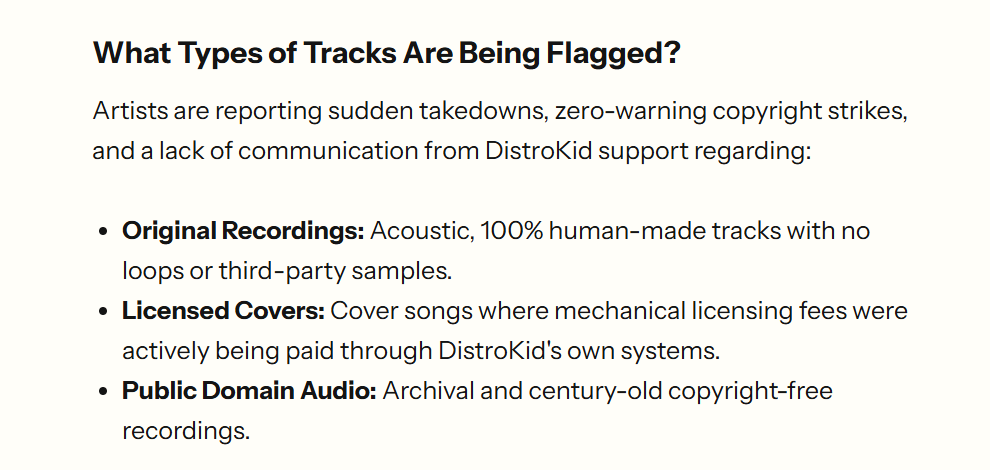
Takedowns are hitting independent catalogues harder than usual. In September 2026, Universal Music Group filed a copyright lawsuit against DistroKid, which the distributor denies. Since then, Hypebot reports that many artists have seen tracks disappear from major platforms, including original recordings, licensed covers and songs that had been live for years. In one case, an artist was accused of using an uncleared sample from a track that was released two years after his own.
Artists described receiving little or no communication until they chased it themselves. That is not a new problem. A 2023 lawsuit reported by Music Business Worldwide argued that independent artists are often left without the information they need to defend themselves against a claim. Whoever distributes your music, you need to know how to act when it happens.
How a takedown actually happens
A rightsholder, or someone claiming to be one, sends a notice saying your release infringes their copyright. That notice goes either to the streaming platform or to your distributor. Spotify’s intellectual property policy says it will evaluate each claim and take appropriate action, which can mean removing the content entirely or blocking it in specific countries.
Your distributor sits in the middle. It delivers your music, receives notices about it and passes on what it knows. How quickly and clearly it does that makes a huge difference to how fast you can respond.
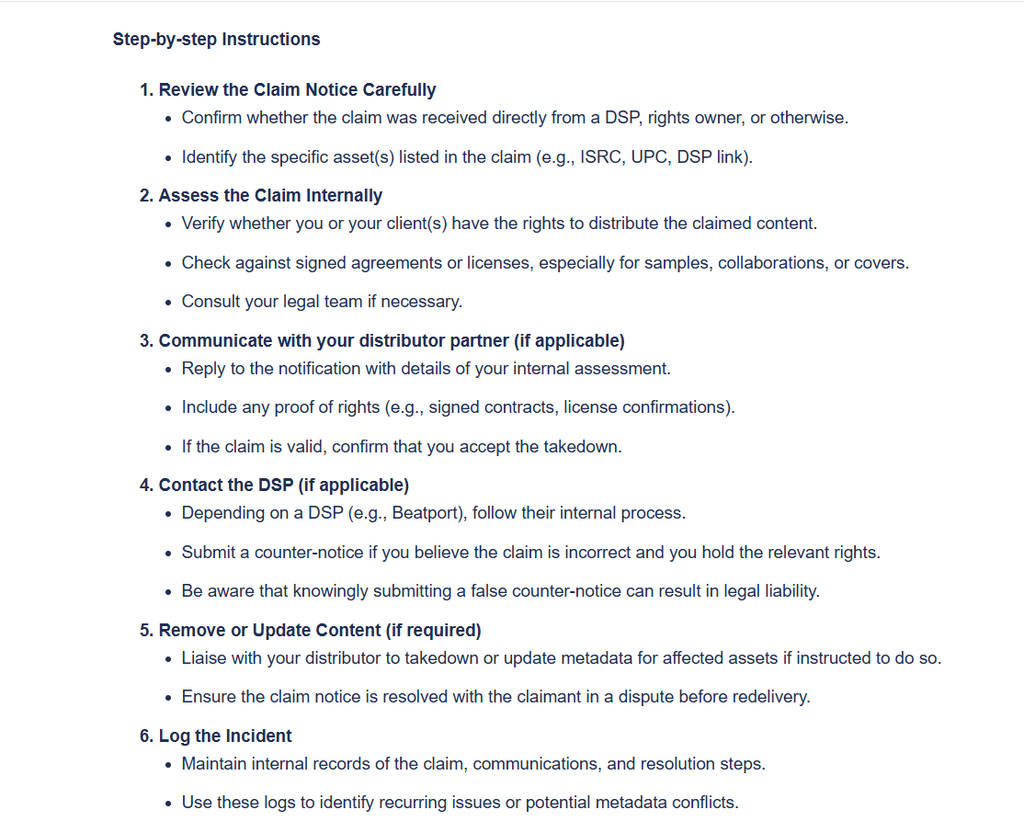
The steps below follow the process that distribution platform FUGA sets out for its clients in its guide to handling a DMCA notice: review the claim, assess it honestly, share your proof of rights, then dispute or resolve it through the right channel.
The most common reasons music gets taken down
Uncleared samples. Clearing a sample usually means getting two separate licences, one for the recording and one for the underlying composition. Spotify for Artists confirms you can expect to need both. Clearing only one leaves you exposed. The same two-licence rule applies to remixes, as our guide to remixes, edits and bootlegs explains.
Covers without the right licence. A cover needs a mechanical licence for the song. In the US, that licence lets you make your own arrangement, but copyright law says it cannot change the basic melody or fundamental character of the work. Rewritten lyrics or a heavily reworked melody usually need permission from the publisher directly.
Collaborator disputes. A featured vocalist, co-producer or former bandmate who believes they own part of the track can file a claim. Without a signed agreement, it becomes your word against theirs.
Mistaken or false claims. Automated matching systems and bad actors both get it wrong. Older recordings, public domain material and tracks that share a sample source are especially vulnerable. Drum and bass producer Peshay found this out when a 1996 studio mix was removed from YouTube over a disputed claim on a legacy track.
Step 1: Find out exactly what was claimed
Before you react, get the facts. Ask your distributor for the affected releases and tracks, including ISRCs and UPCs, which platforms and countries are affected, who made the claim and what they are claiming. Do not accept “a rights issue” as an answer. You cannot assess or dispute a claim you have not seen.
Step 2: Be honest about whether the claim is valid
Check your agreements, licences and clearances against the claim. If you used a sample you never cleared, or released a cover without a licence, the claim may well be legitimate. In that case, accept the takedown, contact the claimant and try to agree a licence or a settlement. FUGA’s guidance is clear that the claim should be resolved with the claimant before the track is redelivered.
If you hold the rights, or the claim is plainly wrong, move on to building your case.
Step 3: Gather your evidence
The artists who win disputes quickly are the ones who can prove ownership on the spot. Pull together:
Original project files, stems and bounced versions, ideally with dates attached. Signed split agreements and collaborator contracts. Sample clearance paperwork and cover licences. Your original release date, ISRCs and distribution records. Any earlier versions, such as uploads to Bandcamp or SoundCloud, that show the track existed before the claimant’s version.
Keep everything in one place and organised by release. You will need it again.
Step 4: Dispute through the right channel
Start with your distributor. Send your evidence and ask them to raise it with the platform and the claimant. Spotify also says you may be able to appeal a claim, with instructions included in its email correspondence about it.
Where the platform operates under US copyright law, you may be able to file a formal counter-notice. According to the US Copyright Office, a counter-notice must include your signature, identify the removed material, state under penalty of perjury that it was removed by mistake or misidentification, and give your contact details and consent to jurisdiction. The platform must then restore the material within 10 to 14 business days, unless the claimant tells it they have started a court action against you.
Take this step seriously. Knowingly filing a false counter-notice can create legal liability, and a counter-notice can lead the claimant to take you to court. If the track is commercially important or the claim involves a large rightsholder, speak to a music lawyer before you file.
Step 5: Do not just upload it again
It is tempting to reupload the track under a new release. Do not. It does not resolve the claim, it is likely to be matched and removed again, and Spotify says it can terminate the accounts of repeat infringers. Wait until the dispute is settled, then redeliver through your distributor with any updated metadata.
How to stop it happening again
Most takedowns can be prevented before release day. Clear every sample and cover before you deliver. Get split agreements signed while everyone is still on good terms. Keep a release file for every track with your project files, licences and contracts. Make sure your metadata is accurate and consistent across every release. Complete credits help too, and our guide to why your song credits now matter shows how to get them right.
Log every claim you receive, along with the messages and the outcome. FUGA recommends this so you can spot recurring problems, such as a metadata conflict that keeps triggering the same match.
Finally, look closely at how your distributor handles claims. A partner who tells you what has been claimed, by whom and what your options are will save you weeks when it matters. The same paper trail also makes it easier to collect neighbouring rights on every recording you own.
YouTube works differently, as most claims there run through Content ID, which can block, monetise or track a video rather than remove your release.
Protect your catalogue before the next claim
A takedown is stressful, but with the right paperwork and the right partner it is usually solvable. MN2S Label Services distributes through FUGA and works with independent artists and labels on distribution and rights management, with advice on every stage of the release process and a team you can actually talk to. Get in touch to talk through your catalogue.
MN2S works with over 500 independent labels on supporting their creative vision. Get in touch today to find out more.
Related articles
 Where Independent Artists Can Find Gigs, Festival Slots and Local Bookings3 Nov 2026How to Build an Inner Circle of Fans Beyond Your Social Media Feed31 Oct 2026
 How to Release Remixes, Extended Mixes and Live Versions So Listeners Can Actually Find Them29 Oct 2026
 How to Get Funding for Your Next Release: Grants for Independent Artists in the US27 Oct 2026
 Releasing Music in Q4: How to Plan Around the Holiday Slowdown and Set Up January25 Oct 2026
 How to Make Your Back Catalogue Earn Again: A Practical Guide for Independent Labels22 Oct 2026