



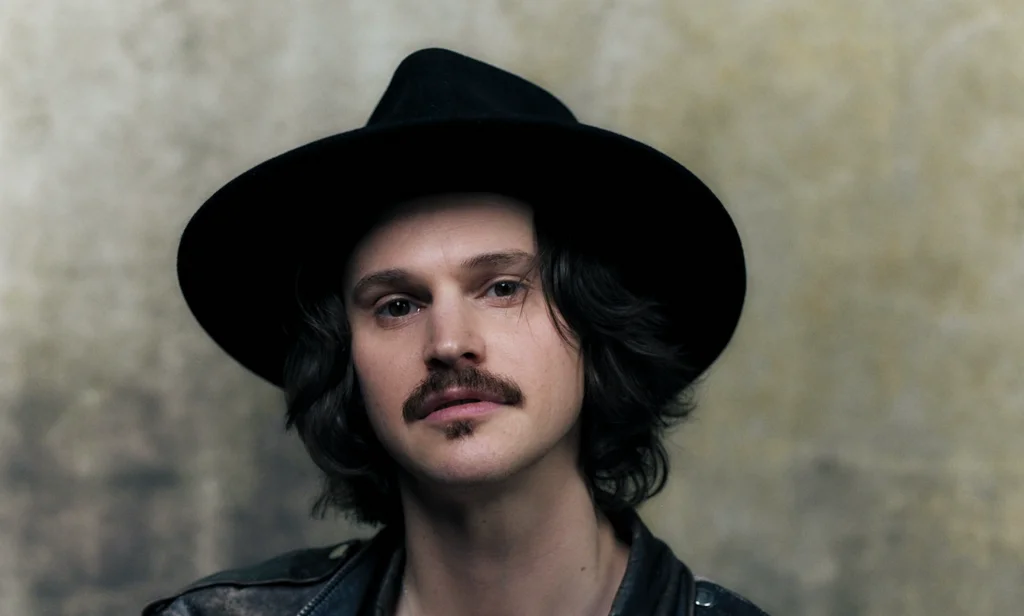
Temple Haze is a Washington, DC-born musician and producer based in Berlin.
Before settling there, he spent nearly three years hitchhiking around the US and Europe, busking on the streets, working on organic farms and living off-grid along the way. That formative period shaped much of his approach as an artist, and its influence still runs through his music today.
Temple’s sound draws on blues and rock roots, developed growing up in the States, and blends them with the trip-hop, ambient and house textures he picked up after moving to Berlin. The result mixes live guitar and vocals with electronic production, a unique hybrid sound that he brings to his breathtaking live shows, which have been described as “electric-groove ceremonies.”
Alongside his solo work, Temple is co-founder and musical director of Soneiro Collective, a project dedicated to exploring the world of sound and its connection to consciousness, that has trained over 200 certified practitioners. He is also a qualified Holistic Voice Mentor and a certified breathwork facilitator, and has collaborated with artists including Oliver Koletzki, Sam Shure and Narou.
His new single I Can Change, a cover of the LCD Soundsystem track, is out July 4, a release date he chose deliberately. We spoke to him about his time on the road, his live performances, and the ideas behind the new single.
You spent years travelling the US and Europe as a hitchhiking musician. How has that shaped who you are as an artist today?
My early years on the road were part of my foundation as an artist. I was quite literally blowing in the wind, which offered so many unexpected and synchronous moments for me. I learned to trust my own path as a creative, my guitar as my companion, and the road offers something intangible in the way of “feeling what the world has to offer”. I played in protest camps, at farms, in exchange for rides and places to sleep. I could feel how my music was opening doors for me, and built confidence busking on the streets to bring my craft to the next level.
Your sound brings together house, ambient, trip-hop, blues and rock influences. How did that blend of styles develop?
It is a story of where I come from in the US and my chosen home of Berlin. My roots are in blues and classic rock music, and once I came to Berlin I learned all about production and dance music. I realized dancing in the clubs of Berlin that sometimes I would miss the musicality of the live music scene I grew up with in the states, and yet gained admiration for the technicality of techno and house music. Once I myself started playing in clubs I wanted to find a way to bring the live rock and blues feeling into the transcendental dancefloor experience. I guess in this way my own style developed, taking the hypnotic rhythms of house music and blending them with my wailing guitar riffs and vocals; finding that sweet spot of electronic and soul.
Your live shows are described as “electric groove ceremonies.” What experience do you try to create for the audience in a live performance?
Being a musician all my life, at some point i realized the music moves through me, I feel more like a vessel than the owner of my sound. When I get on stage there is an energy that presents itself and I try to ride that wave. It’s kind of like my own sonic-spiritual practice, infused with groove, combined with the electronics and effects. And it’s not just my own world, it’s an interaction or even sometimes a “ceremony” with the audience. The stage and dancefloor can be a profound emotional release space, and I love to facilitate it with wild abandon.
Your new single I Can Change is out on July 4. What’s the idea or story behind the track?
LCD Soundsystem is a band that I feel also creates what I feel is rock infused dance music, in a similar vein to my current direction, and I simply love their catalog. When I was feeling inspired to do a cover, I Can Change felt like just the right one. I wanted to keep the 80’s dance-pop vibe but infuse it with more groove, funky bass lines and filtered guitars.
Was there a reason you chose July 4 for the release, and does that date connect to the message of the song?
To me, I Can Change is all about the push and pull that presents itself in relationship. It can also be viewed as a quasi rom-com, satiric view of how we romanticize others, and wish things could be different, change things, how we could possibly will ourselves to change “if it helps you fall in love”. On a more serious note, I do believe we all can change and have the capacity to become radically different people through inner work (the key is actually doing the work).
July 4th, 2026 is the 250th birthday of the USA, a country that is my homeland – and it’s in need of serious change. I chose this release date as a slightly satirical protest to the current regime and political situation happening in the US right now, where politicians seems to be pretending they can change (or that they will drain certain swamps, only to become said swamp) so that the public stays in love with them, but more and more people are waking up to the fact the real change isn’t just talked about, it’s enacted, and it’s not happening in the way many had hoped it would.
Just as the protagonist in I Can Change wants to will himself to be a different person so she will fall in love again (the question is – is he being honest or is it just conjecture?), in the same vein, can we find people willing to enact real change on a bigger level or is it just talk? I honestly don’t know, but I still have hope, and know we can still support those who we feel really can change things.
Your music often mixes humour, spirituality and psychedelic elements. How do those ideas come together in your writing?
My writing process has become really intuitive over the years. Rather than try to compose anymore, I wait for inspiration to hit me (often in the shower) and then get it in a voice memo as quickly as I can. I then try to ride that wave and get the basics into ableton just as fast. As I compose from this intuitive space, my own journey is what I’m always singing about, each song I write these days is just a reflection of where I am and what’s present, whether it’s humor or my spiritual path. The psychedelic stuff, well that’s just my musical upbringing, Jimi Hendrix, David Gilmour, Robby Krieger, and so on, that’s my Guitar DNA.
Alongside music, you run Soneiro and work with voice and breathwork. How did that side of your work begin?
At some point I realized that playing in clubs and venues was not bringing me a deeper sense of fulfillment. This led me to begin walking a different path where I co-founded Soneiro and we began exploring the world of sound immersions and the science of sound. As I discovered the healing power of sound it also led me on deeper work with my voice, which naturally is connected to the breath. I then also completed my trainings in Holistic Voice Work and Alchemy Re:Wire Breathwork and offer these modalities as part of my Sound Trainings with Soneiro.
Learn more about Sonerio’s Sound Trainings and offerings here.
What does Soneiro mean to you personally, and what do you hope people take away from the sound training and experiences you offer there?
Soneiro is a project deeply rooted in sharing the medicine of sound with integrity. We have trained over 200 alumni, certified sound meditation practitioners, who are also now sharing their sonic gifts with the world. As an artist and facilitator I have the privilege to gather people together and have a positive impact on their lives, I know sound can be a catalyst of deep inner change which can then influence change out in the world, that is how I try to do my part.
Do your Soneiro practices influence how you make or perform music as Temple Haze?
100%. Working with sound in this holistic way has shown me new pathways to understand how music is affecting that audience and how it affects me. There is a lot more joy in my music and in my live shows since founding Soneiro.
You’ve worked with artists like Oliver Koletzki, Sam Shure and Narou. What have those collaborations taught you?
Working with talented producers is always inspiring to see their workflow, and notice where the tracks go with multiple people in the room. It’s a great moment to see how each person’s talent shines through the songs, and to see how one can bounce off the ideas of the other, to get to something where you are both very happy with. All three of them are also very humble and fun guys to be with in the studio, and that’s a must for me, not EGO trips allowed in the studio on my watch.
Looking ahead, what’s next for you after I Can Change?
Festival season is in full swing here in Europe so I’m looking forward to bringing my live set to some very cool concerts and events, in Europe, Ibiza, Mexico, etc. Summer is my main season of touring, then when autumn arrives I’ll dive back into deep studio work.
One thing I am in post production on now is a fully acoustic EP, I’ve had it in the works for a while and waiting for the right moment to bring the soft, melancholic, folky, bluesy acoustic sound out there. A back to the roots moment. Feels like an autumn EP to me .