



The Song Never Died. Your Brand Just Wasn’t Listening.
Boney M are 50 years old in 2026. And Rasputin is trending again. The group formed in 1976. Their 1978 anthem has now had multiple TikTok resurrection moments, including a dance challenge in early 2021 that pushed the track onto the Billboard Global Excl. U.S. chart for the first time in its history, logging 7.5 million streams in a single week outside the U.S. alone. Then again in 2025 and 2026, when the queer ice hockey series Heated Rivalry sent fans flooding back to the track, making edits of Russian heartthrob Ilya Rozanov set to “Ra Ra Rasputin.” The show’s creator Jacob Tierney told Rolling Stone he knew the moment they placed it: “I did not think I could afford it, but as soon as we put it in, I was like, ‘Oh, we need this.’”
Kate Bush has now done it twice. “Running Up That Hill” posted an 8,700% spike in global Spotify streams after appearinThe Song Never Died. Your Brand Just Wasn’t Listening.anger Things Season 4 in 2022, hit number one in eight countries, and earned Bush an estimated $2.3 million in streaming royalties in a single month. Then Stranger Things Season 5 in late 2025 sent it back to the charts again, past 1.5 billion Spotify streams, number 14 on the UK singles chart in January 2026.
This year, “Wuthering Heights” racked up 560,000 streams in five days after Emerald Fennell’s Wuthering Heights film (starring Margot Robbie and Jacob Elordi) hit cinemas.
None of this is luck. It is a pattern. And brands that understand the pattern are sitting on one of the most powerful activation opportunities in marketing right now.
The Algorithm Doesn’t Care How Old the Song Is
The streaming era changed something fundamental. Catalog music (tracks older than 18 months) now accounts for approximately 73% of all U.S. on-demand audio streams, according to Luminate’s Year-End 2025 report. In Q1 2026, roughly 22% of Billboard Hot 100 entries had a documented TikTok-driven origin. The feed doesn’t timestamp. If a sound fits a moment, it travels. Legacy tracks carry decades of emotional association that new releases simply cannot replicate.
This is why investors are paying billions to own old music. Sony bought half of Michael Jackson’s catalog for $600 million. Queen’s catalog sold for $1.27 billion. Warner Music launched a $1.2 billion joint acquisition vehicle in 2026 specifically targeting catalog. These are not sentimental purchases. They are bets on a proven mechanism: catalog music resurfaces, repeatedly, when the right cultural trigger arrives.
Brands have mostly watched this happen from the sideline. The smarter play is to be the trigger.
The Mechanism Is Bookable
Here is what the Boney M and Kate Bush examples actually demonstrate for a marketing team.
First, the artist does not need to be actively releasing new music to be culturally relevant. Boney M formed in 1976. Fifty years on, they are on their Final Curtain Tour, celebrating that milestone with dates from the UK to Australia, and performing at major international events like the Joy Awards in Riyadh. The demand is there. The artist is available. What is missing, in most cases, is a brand with the imagination to make use of it.
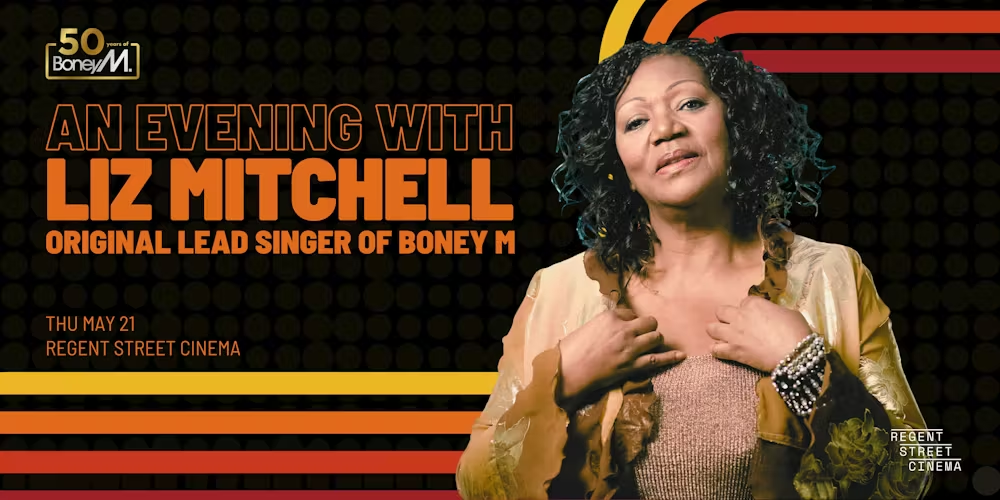
Second, the revival moment generates earned media far beyond the initial activation. When MN2S booked Liz Mitchell, the original voice of Boney M, to perform at the Joy Awards 2026, that was not just a live event. It was a cultural touchpoint that landed alongside the broader Rasputin-trending-again moment, in one of the highest-profile entertainment showcases in the Middle East. The ripple effect is disproportionate to the initial spend.
Third, legacy artists bring cross-generational audiences in a single booking. A 25-year-old who knows Rasputin from Heated Rivalry and a 55-year-old who bought Nightflight to Venus on vinyl are both in the room. That is a brief that most brands spend years trying to crack and almost never achieve with contemporary talent alone.
What Smart Activation Actually Looks Like
The mistake brands make is thinking about legacy artist partnerships narrowly: a nostalgia play, a heritage moment, a retro campaign. That framing misses the opportunity entirely.
Think about what Boney M feat. Maizie Williams can do in 2026. Not a throwback. A live campaign anchor for a brand that wants to own a summer festival moment, a product launch with genuine emotional resonance, a content series that rides an already-building algorithm wave. Pair that with a TikTok-native creator who understands how catalog tracks travel on the platform and you have two audiences, two distribution channels, and a story that writes itself.
Think about what Boney M feat. Liz Mitchell, the original voice behind those 150 million records sold, with the authority to stop any room, can do at a corporate event, a broadcast campaign, a global partnership activation in markets where Boney M’s music has been playing at weddings and celebrations for five decades.
The Kate Bush model is the benchmark. “Running Up That Hill” did not go viral by accident in 2022. It was placed deliberately by a music supervisor who fought for it for years, knowing exactly what it would do. The Heated Rivalry creator nearly didn’t use Rasputin because of the cost, then did it anyway because he understood the cultural weight it carried.
Brands rarely think with that level of intentionality about legacy music partnerships. The ones that do win cultural moments that feel genuinely surprising, and completely inevitable in retrospect.
The 50th Anniversary Is a Window, Not Just a Footnote
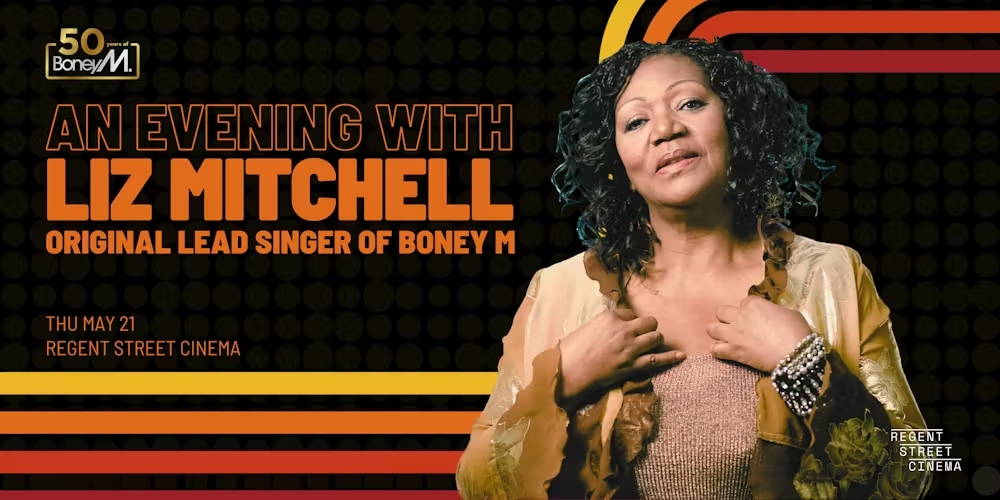
Boney M’s 50th anniversary is not a nostalgia story. It is a live trigger. The Final Curtain Tour is running now, with dates across the UK, Australia, New Zealand, and Germany. The Heated Rivalry effect has the Rasputin conversation active across global social media. The dance challenge, the edits, the fan content. It is all building, again, on its own.
For a brand, this is what a ready-made cultural moment looks like before it peaks. Stranger Things Season 4 launched and then brands scrambled to attach themselves to the Kate Bush wave. The window to be ahead of that curve, to be the brand that activated first, that created the moment rather than chased it, had already closed by the time most marketing teams had their briefs written.
The Boney M moment is open right now.
The Biggest Proof Point of All Is Happening Right Now
If Boney M and Kate Bush illustrate the pattern, Michael Jackson’s biopic Michael demonstrates its full scale.
The film opened in cinemas on April 24, 2026, directed by Antoine Fuqua and starring Jackson’s nephew Jaafar Jackson in the lead role. It debuted to $97.2 million domestically, the biggest opening weekend in the history of music biopics, surpassing Straight Outta Compton’s $60.2 million record set in 2015. By its third weekend it had crossed $300 million worldwide, unseating Elvis to become the second-highest grossing musical biopic ever, behind only Bohemian Rhapsody.
The box office story is remarkable. The music story is the one that matters here.
According to Billboard, Jackson’s catalog was already setting new personal streaming bests in the weeks before the film opened. In the week of April 17 to 23 alone it registered 55.3 million on-demand streams. After opening weekend, that number was tracking to become his biggest U.S. streaming week ever. “Billie Jean” hit 4 million U.S. streams in a single week. “Beat It” followed at 2.9 million. The teaser trailer, a mashup of “Wanna Be Startin’ Somethin’”, “Human Nature”, “Don’t Stop ‘Til You Get Enough” and “Billie Jean”, was viewed 116.2 million times in its first 24 hours, more than any trailer for a musical biopic or concert film in history.
This is what a fully activated catalog moment looks like at scale. A film that was not even a good one by critical consensus (39% on Rotten Tomatoes) was enough to double the streaming numbers of one of the most-streamed catalogs on the planet.
For brands, the lesson is not that you need a $200 million film to move the needle. The lesson is that cultural context does the work. The film created the context. Brands that had already built partnerships with the Jackson legacy (licensed products, campaign tie-ins, experiential activations) were riding that wave from day one. The brands that were watching from a distance were still writing briefs by the time “Billie Jean” peaked.
A sequel, Michael 2, is already confirmed for 2028. That wave is coming again. The question is whether your brand plans to surf it or watch it.
The Strategic Takeaway
Legacy artists are not a consolation prize for brands that cannot afford contemporary talent. They are a distinct category of cultural asset: proven catalog heat, cross-generational audiences, and a demonstrated ability to dominate streaming charts and social feeds without a single new release.
The pattern is consistent. The mechanism is understood. The talent is bookable.
If you want to talk to a specialist agency about how to build a campaign around legacy music talent, whether that is Boney M, another artist from the same era, or a broader nostalgia-meets-now strategy, get in touch with the team at MN2S.