

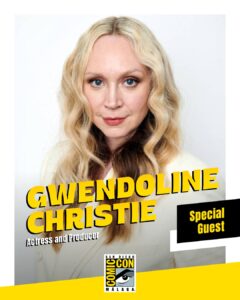
Gwendoline Christie Announced for San Diego Comic-Con Málaga Panel
1 year ago


 United States
Brad Mehldau transcends jazz piano, weaving classical romanticism, pop allure, and innovative experimentation into his performances and compositions, influencing a generation of musicians.
Interested in booking Brad Mehldau?
Request A ShowNonesuch Records released *Modern Music*, a collaboration between pianists Brad Mehldau and Kevin Hays and composer/arranger Patrick Zimmerli, on September 20. Mehldau has released multiple albums with Nonesuch, an imprint of Warner Bros.
Mehldau recorded *Introducing Brad Mehldau* for Warner Bros. Records, his first album as sole leader. His first album for Nonesuch Records, an imprint of Warner Bros., was *Live in Tokyo*.
Carnegie Hall commissioned a song cycle from Mehldau for classical music singer Renée Fleming, premiered in spring 2005. Later, Carnegie Hall awarded Mehldau another commission—to write the song cycle *Love Songs* for singer Anne Sofie von Otter, premiered in 2009. From 2010–11, Mehldau held Carnegie Hall's Richard and Barbara Debs Composer's Chair, becoming the first jazz musician to do so.
Mehldau began a two-year period as curator of London's Wigmore Hall jazz series in 2009. He also performed another commissioned song cycle at Wigmore Hall with Ian Bostridge in 2019. He received the Wigmore Medal in 2015, which recognizes significant figures in the international music world who have a strong association with the Wigmore Hall.
In 2012, Mehldau and the Orpheus Chamber Orchestra performed his "Variations for Piano and Orchestra on a Melancholy Theme" in Europe, a piece originally for solo piano converted for a commission by the Orchestra. It was performed in the US the following year.
Born Bradford Alexander Mehldau on August 23, 1970, in Jacksonville, Florida, he was introduced to the piano early, initially exploring pop and rock music. His family relocated to West Hartford, Connecticut, where a new piano teacher sparked his interest in classical music. By age 14, Mehldau had shifted his focus to jazz, studying recordings of John Coltrane and Oscar Peterson, and finding significant inspiration in Keith Jarrett’s *Bremen/Lausanne*. During high school, he actively transcribed jazz solos, performed regularly at a local club, and received the Berklee College of Music’s Best All-Round Musician Award. In 1988, Mehldau moved to New York City to study jazz at The New School on a partial scholarship, where he trained under notable pianists Fred Hersch, Junior Mance, and Kenny Werner. While still a student, he toured with saxophonist Christopher Hollyday, an experience that helped him assimilate the styles of Wynton Kelly and McCoy Tyner, leading to the development of his unique sound.
Mehldau’s career began to solidify in the early 1990s. He made his first recording with Hollyday in 1991 and toured Europe that same year. His interest in classical music rekindled in his early twenties, prompting him to refine his left-hand technique. He formed his first long-term trio in 1994 with bassist Larry Grenadier and drummer Jorge Rossy, a collaboration that would define a significant period of his career. In 1995, he released *Introducing Brad Mehldau* on Warner Bros. Records, his debut as a sole leader, which garnered positive critical attention. This was quickly followed by *The Art of the Trio Volume One* in 1996, further solidifying his reputation. Throughout the mid-to-late 1990s, Mehldau gained recognition as a leading jazz musician, celebrated for his intricate improvisations and ability to integrate diverse musical influences. He expanded his involvement in film music, moving from playing on soundtracks like *The Million Dollar Hotel* (2000) to scoring *Ma femme est une actrice* (2001). His departure from traditional jazz structures and incorporation of pop and rock elements made him a significant figure in contemporary jazz.
The 2000s saw Mehldau continue his artistic evolution, exploring new formats beyond the trio. His 2002 album *Largo*, produced by Jon Brion, incorporated electronics and contributions from rock and classical musicians, becoming his best-selling album. He collaborated with guitarist Pat Metheny, recording two albums and embarking on a world tour in 2007. Mehldau also developed song cycles for classical singers Renée Fleming and Anne Sofie von Otter, premiering works at Carnegie Hall. In 2009, he released *Highway Rider*, an orchestral project featuring his trio and a 28-piece orchestra. He held Carnegie Hall’s Richard and Barbara Debs Composer’s Chair from 2010 to 2011, the first jazz musician to do so. His work with drummer Mark Guiliana as the electronic duo “Mehliana,” and diverse projects such as “Variations for Piano and Orchestra on a Melancholy Theme” with the Orpheus Chamber Orchestra, showcase his continuous exploration of musical boundaries. Mehldau’s influence on jazz has been profound, with his unique approach to counterpoint, rhythmic complexity, and expansive repertoire shaping contemporary jazz piano.

Curious about our offerings or have inquiries? We're eager to assist!
Just complete the form, and we'll respond promptly.