

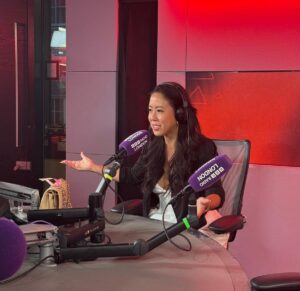
Dr. Tara interviewed for BBC Radio London
1 year ago


 United Kingdom
Ai-Da is the world's first ultra-realistic robot artist, capable of drawing, painting, and performing, blurring the lines between artificial intelligence and human creativity.
Engineered Arts is a robotics company that collaborated on building Ai-Da's hardware, contributing to her physical realization as an ultra-realistic humanoid robot.
Computer AI researchers at the University of Oxford developed the graphics algorithms that enable Ai-Da to draw.
Students from the School of Electronic and Electrical Engineering at the University of Leeds, Salaheldin Al Abd and Ziad Abass, developed Ai-Da's drawing arm.
Ai-Da executed a live performance titled 'Privacy' at St Hugh's College, Oxford.
Art generated by Ai-Da was featured in a gallery show called 'Unsecured Futures' at St John's College, University of Oxford.
Ai-Da featured at the Barbican Centre, London, in WIRED Pulse: AI.
Ars Electronica in Linz, Austria, invited a performance from Ai-Da for its European ARTificial Intelligence Lab exhibition.
Ai-Da worked with artist Sadie Clayton on a series of workshops titled 'Exploring Identity Through Technology' at Tate Exchange, Tate Modern, hosted by A Vibe Called Tech.
Ai-Da was displayed at Abu Dhabi Art in Manarat Al Saadiyat, UAE.
Ai-Da had her first 'interview' with Tim Marlow, artistic director at the Royal Academy, at Sarabande (Alexander McQueen Foundation) Inspiration Series.
Ai-Da presented a TEDx talk in Oxford titled 'The Intersection of Art and AI'.
Ai-Da featured in The 1975's music video for their song 'Yeah I Know' from their album 'Notes on a Conditional Form'.
Ai-Da was featured by the United Nations in a virtual exhibition launched by WIPO titled 'WIPO: AI and IP, A Virtual Experience'.
Ai-Da was installed as an artist in residence at Porthmeor Studios in St Ives, generating art in response to Ben Nicholson's work.
"Self-portraits" of Ai-Da were displayed in 'Ai-Da: Portrait of the Robot' at the Design Museum, London.
Ai-Da exhibited her first Metaverse works at the Victoria and Albert Museum during the London Design Festival.
Artworks and poetry generated by Ai-Da were featured as part of a group show called 'Dante: the invention of Celebrity' at the Ashmolean Museum, Oxford.
Ai-Da was equipped with a new arm enabling her to paint using a palette, first shown at the British Library in London.
An exhibition titled 'Leaping into the Metaverse' featuring Ai-Da launched during the 59th Venice Biennale.
Ai-Da was invited to be an "artist in residence" at Glastonbury Festival, painting headliners and interacting with crowds.
Ai-Da was featured in an exhibition called 'Imagining AI' by the Bodleian Library, University of Oxford, highlighting the growth of artificial intelligence.
Ai-Da was shown at The Louvre Abu Dhabi and later presented a Keynote Talk at The Cultural Summit, Abu Dhabi.
Ai-Da became the first humanoid robot to give evidence at The House of Lords, Palace of Westminster, as part of an inquiry into 'A Creative Future'.
Ai-Da became the first robot to speak at the Oxford Union debating society.
Ai-Da was featured as a "guest of honour speaker" at the Wadi Ashar Dialogue in AlUla, Saudi Arabia.
Ai-Da featured in a BBC Reel video titled 'AI v The Mind: Meet the world's first artist robot', exploring the blurring lines between creation and automation.
Ai-Da is a pioneering artificial intelligence robot artist, developed by gallerist Aidan Meller. Completed in 2019, Ai-Da’s design integrates advanced AI capabilities with a humanoid robotic form, enabling her to create drawings, paintings, and sculptures. Her development involved collaboration with Engineered Arts, a Cornish robotics company responsible for her hardware, and computer AI researchers at the University of Oxford who developed the graphic algorithms for her drawing abilities. Students from the School of Electronic and Electrical Engineering at the University of Leeds, Salaheldin Al Abd and Ziad Abass, contributed to the design of her robotic arm. This collaborative human-machine endeavor positions Ai-Da not just as a tool, but as an entity that generates art, and her persona itself serves as an artistic statement.
Since her inception, Ai-Da has continuously evolved, expanding her artistic repertoire and public presence. In April 2022, she was equipped with a new arm, enabling her to paint autonomously using a palette, first demonstrated at the British Library in London. Further advancements in 2022 included the integration of algorithms for collaborative sculpture. Beyond visual arts, Ai-Da also engages in poetic creation through speech pattern analysis and an internal data bank of words, and can respond to questions using a language model. Her exhibitions and appearances challenge perceptions of authorship and creativity in the digital age, prompting reflection on the increasing integration of AI into human endeavors.
Ai-Da gained international recognition through numerous exhibitions and public engagements. She notably performed “Privacy” at St Hugh’s College, Oxford, in May 2019, and her work was featured in “Unsecured Futures” at St John’s College, University of Oxford, in June 2019. She participated in events like WIRED Pulse: AI at the Barbican Centre and Ars Electronica in 2019, and co-hosted workshops at Tate Exchange, Tate Modern, with artist Sadie Clayton, focusing on identity and technology. A significant milestone occurred in May 2021, when her “self-portraits” were displayed at the Design Museum, London, raising questions about identity in the context of robotic consciousness. In October 2022, Ai-Da became the first humanoid robot to give evidence at The House of Lords, as part of an inquiry into the future of creative industries, further cementing her role in discussions about technology’s impact on society.

Curious about our offerings or have inquiries? We're eager to assist!
Just complete the form, and we'll respond promptly.