
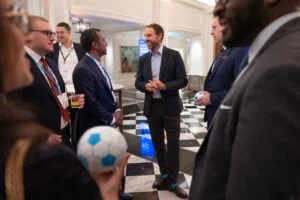
Gareth Southgate Brings Leadership Insight to Barclays Global QIS Conference
2 weeks ago


 Germany
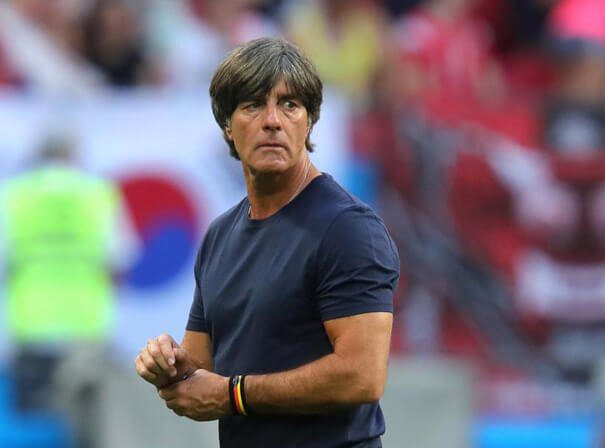
Joachim Löw, a former footballer, has transitioned into a highly successful football coach, leading his teams to significant national and international victories.
Joachim Löw has an ongoing collaboration with NIVEA MEN, which includes global campaigns and promotional activities. He renewed his deal with Beiersdorf Group to promote its Nivea products for another two years.
As the DFB's official coach partner, MAN supplies new team coaches for the German national team, transporting Joachim Löw's team.
Joachim Löw has been seen wearing an IWC Portuguese Yacht Club Chronograph, reflecting a past relationship between the German Football Association and the luxury watch manufacturer.
Mercedes-Benz partnered with the German national football team, highlighting a shared philosophy of striving for reinvention.
Löw was part of a collaboration between the German Football Association and The LEGO Group, resulting in a Europe-exclusive collectible minifigure series in May 2016, with Löw featured as the first of sixteen minifigures.
Joachim ‘Jogi’ Löw was born on February 3, 1960, in Schönau im Schwarzwald, Germany. He began his playing career in 1978 with 2. Bundesliga club SC Freiburg, where he had three stints and became the club’s all-time leading scorer until 2020. His playing career also included spells with VfB Stuttgart, Eintracht Frankfurt, and Karlsruher SC in the Bundesliga, and later with FC Schaffhausen and FC Winterthur in Switzerland. After retiring as a player, Löw promptly shifted his focus to coaching, starting as a youth coach for FC Winterthur and player-coach for FC Frauenfeld in the early 1990s. This early exposure to management laid the groundwork for his future leadership roles.
Löw’s club management career began with VfB Stuttgart in 1995 as an assistant coach, quickly progressing to permanent manager in 1996. During his tenure, he secured the DFB-Pokal in 1997 and reached the UEFA Cup Winners’ Cup final in 1998. He then managed clubs like Fenerbahçe in Turkey, Karlsruher SC, Adanaspor, and FC Tirol Innsbruck, where he notably won the 2001–02 Austrian Football Bundesliga title. His time at Austria Wien also saw the team win the 2003 Austrian Supercup. In 2004, a significantturning point came when he joined the Germany national team as assistant manager under Jürgen Klinsmann, where they implemented a new attacking philosophy and reached the semi-finals of the 2005 FIFA Confederations Cup and the 2006 FIFA World Cup.
In 2006, Löw was appointed the head coach of the Germany national team, a position he held until 2021. Under his leadership, Germany achieved substantial success, reaching the final of Euro 2008 and the semi-finals of the 2010 FIFA World Cup and Euro 2012. The pinnacle of his career came in 2014 when he led Germany to win the FIFA World Cup in Brazil, followed by a victory at the 2017 FIFA Confederations Cup. Despite a group stage exit from the 2018 World Cup and a last-16 exit at Euro 2020, Löw’s 15-year tenure as national team coach was marked by a transformative impact on German football. He managed the most matches (198) and secured the most wins (124) of any Germany national team coach.

Curious about our offerings or have inquiries? We're eager to assist!
Just complete the form, and we'll respond promptly.