


Gareth Southgate Brings Leadership Insight to Barclays Global QIS Conference
6 days ago


 Poland
Miroslav Klose, a German football legend, transitioned from an iconic striker into a respected coach, bringing his unparalleled experience in international tournaments to new generations of players.
Summary of Miroslav Klose's brand value and its role in his financial success, stemming from his status as a football icon.
Miroslav Klose was born on June 9, 1978, in Opole, Poland, the son of professional athletes. His father, Josef Klose, was a professional footballer for Auxerre, and his mother, Barbara Jez, played for the Polish women’s national handball team. Klose moved to Kusel, West Germany, at the age of seven. Despite an initial rejection from a local sports school due to his slight build, he developed his football skills with youth teams SG Blaubach-Diedelkopf and FC Homburg. Klose began his professional career in 1998 with FC Homburg’s reserve squad before joining 1. FC Kaiserslautern a year later. He made his top-tier Bundesliga debut in April 2000, achieving a breakout season in 2001–02 with 16 goals.
Klose’s club career saw him join Werder Bremen in March 2004 for a €5 million transfer fee, where he scored 15 goals in his first season and was the Bundesliga top scorer in 2005–06 with 25 goals. In June 2007, he moved to Bayern Munich, contributing to two Bundesliga titles (2007–08, 2009–10) and a German Cup win. His tenure at Bayern also included scoring the deciding goal in the 2010 German Supercup. In June 2011, Klose moved to Lazio in Italy’s Serie A, where he made history by scoring five goals in a single match against Bologna in May 2013, a feat not accomplished in Serie A since 1986. He concluded his playing career with Lazio in 2016, having scored 64 goals for the club and winning the Coppa Italia in 2013.
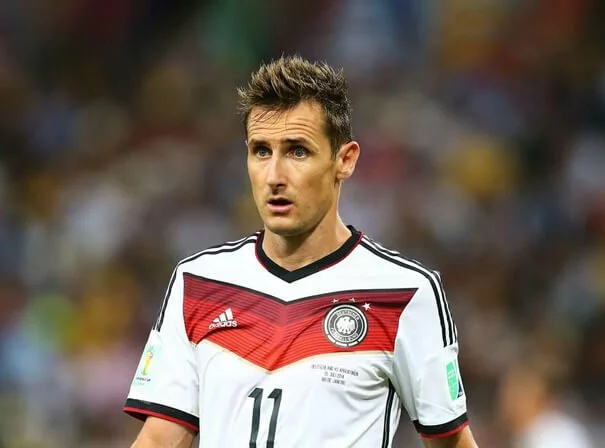
Internationally, Klose represented Germany, making his debut in March 2001 and scoring the winning goal against Albania. He became the all-time leading goal scorer in men’s FIFA World Cup history with 16 goals, notably achieving this record during Germany’s 2014 World Cup victory. His five goals in his debut 2002 World Cup earned him the Silver Boot, and he won the Golden Boot in the 2006 World Cup with five goals. After retiring from playing, Klose transitioned into coaching, serving as an assistant coach for the German national team, followed by roles as Bayern Munich’s under-17 coach and assistant manager for the senior team. He later took on head coaching positions at SCR Altach in the Austrian Bundesliga and, currently, at 1. FC Nürnberg.

Curious about our offerings or have inquiries? We're eager to assist!
Just complete the form, and we'll respond promptly.