

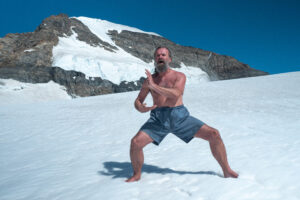
Wanderlust Partners with Wim Hof for the Wellspring Wanderlust x Wim Hof Experience 2025
12 months ago


 United Kingdom
Stephen Fry has established himself as a prominent British actor, comedian, broadcaster, and writer, recognized for his extensive contributions to stage, screen, and literature.
Appeared as "Count Ivan Skavinsky Skavar" in a 1982 advertisement.
Appeared in advertisements.
Appeared in advertisements.
Appeared in advertisements.
Appeared in advertisements.
Appeared in advertisements.
Appeared in advertisements.
Appeared in advertisements.
A series of advertisements which also featured Hugh Laurie.
Appeared in advertisements.
Appeared in advertisements with Paul Merton.
Appeared in advertisements.
Appeared in advertisements.
Fronted a new flavour of potato crisps for Comic Relief: 'Stephen Fry Up'.
Appeared in advertisements.
Partnered with to promote UK tech in the US. Supported by Darktrace, Deepmind, Revolut, and Matillion.
Revealed his participation in a viral advertising stunt for the charity.
Appeared in a new poster campaign from the Chartered Institute of Library (implied through text).
Backed entrepreneurs who raised thousands for charity through their specialist branded clothing business, OHM Clothing.
Backed children's fairy tale app in aid of UNICEF, along with other British celebrities.
Appeared in a film made by the Free Software Foundation to celebrate the 25th anniversary of the GNU Project.
Designed a Paddington Bear statue, auctioned to raise funds for the National Society for the Prevention of Cruelty to Children.
Stephen John Fry was born on August 24, 1957, in Hampstead, London. His early life involved attending Uppingham School and Queens’ College, Cambridge, where he studied English Literature and graduated with an upper second-class honours in 1981. While at Cambridge, he met Hugh Laurie and Emma Thompson, becoming a member of Footlights, a student comedy revue. His collaborative writing with Hugh Laurie began in 1981, leading to successful Footlights revues and a three-month tour of Australia. In 1984, Fry was engaged to rewrite the Noel Gay musical “Me and My Girl,” which achieved significant success and earned him a Tony Award nomination in 1987. Throughout the 1980s, Fry expanded his work into television and radio, also writing columns for newspapers like the “Daily Telegraph” and articles for magazines such as “Arena.” He gained particular recognition for his roles in “Blackadder II” (1986) as Lord Melchett and “Jeeves and Wooster” (1990) as Jeeves.
His career saw a significant turn with his critically acclaimed portrayal of Oscar Wilde in the 1997 film “Wilde,” which earned him a Golden Globe nomination for Best Actor. He became the original host of the comedy panel game “QI” (Quite Interesting) in 2003, a role he held until 2016, receiving a Rose d’Or award for “Best Game Show Host” in 2006. Fry has also made notable contributions as a writer, publishing four novels, including the best-selling “The Liar” (1991) and “Making History” (1996), which earned the Sidewise Award for Alternate History. His literary work also includes three volumes of autobiography: “Moab Is My Washpot” (1997), “The Fry Chronicles” (2010), and “More Fool Me” (2014).
Beyond his acting and writing, Fry is known for his extensive voice-over work, including narrating the British versions of all seven “Harry Potter” audiobooks. He has also been a prominent advocate for mental health awareness, particularly for bipolar disorder, which he openly discusses. His documentary “Stephen Fry: The Secret Life of the Manic Depressive” (2006) won an Emmy Award. In 2025, he was knighted for his services to mental health awareness, the environment, and charity, further cementing his impact beyond entertainment into significant societal contributions. He has served as president of the mental health charity Mind since 2011 and has been actively involved with various charitable causes and campaigns.

Curious about our offerings or have inquiries? We're eager to assist!
Just complete the form, and we'll respond promptly.