



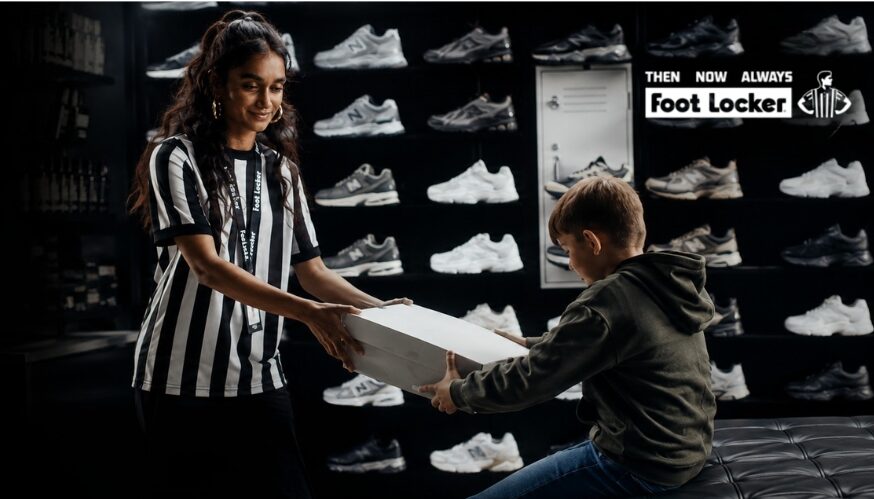
Foot Locker’s “Then. Now. Always.” film traces six decades of European sneaker culture through the music and street style that shaped it, with MN2S securing the voice behind the campaign.
Sneakers have never just been shoes. From playground courts to festival fields, they have carried the sound of the streets on their backs, and Foot Locker’s new campaign puts that relationship front and centre.
“Then. Now. Always.” is a short film built around one idea: sneaker culture and music culture grew up together. The campaign moves through decades of European street style, from Air Jordans on Italian basketball courts to Stan Smiths on English five-a-side pitches to TNs on Parisian streets. Each era gets its own visual signature and its own soundtrack, narrated by a voice that carries genuine weight in UK underground music culture. If you recognise the voice, then you’re the audience they’re talking to.
MN2S secured that voice for the campaign. The agency connected the dots between Foot Locker’s creative vision and a narrator whose career sits at the exact intersection the brand wanted to celebrate: the point where music scenes and sneaker culture became the same culture.
Why hip-hop and sneaker culture have always been the same story
Hip-hop didn’t just influence sneaker culture. In many ways, it built it. Run-DMC’s partnership with Adidas in the mid-1980s turned trainers into a badge of identity rather than just sportswear, and the industry never looked back. Michael Jordan and Nike followed with a different kind of cultural moment, one that fused basketball, fashion, and aspiration into a single silhouette.
That pattern repeated itself across every music scene that followed. Garage, grime, and jungle all had their own footwear codes in the UK, just as hip-hop did in the US. Trainers became shorthand for where you were from, what you listened to, and who you ran with. Brands understood this instinctively, even before marketing departments had language for it.
Foot Locker’s campaign leans into that history rather than glossing over it. The film treats sneaker culture as inseparable from music culture, and the choice of narrator reinforces that link. A voice with deep roots in UK underground music brings automatic credibility to a story about street style, because that audience can tell the difference between a brand borrowing culture and a brand that actually understands it.
The strategic thinking behind the campaign
Brand partnerships and or content built on nostalgia can misfire easily. Lean too hard into the past and a campaign feels like a museum piece. Foot Locker avoids that trap by keeping the tone forward-facing. The “Then. Now. Always.” structure treats history as a throughline rather than a destination, which keeps the film feeling current even as it references decades-old moments.
This matters commercially, too. Sneaker culture spans multiple generations of shoppers, and a campaign that only speaks to one age group leaves value on the table. By pairing archive-era references with a narrator whose voice signals authenticity to younger, culturally engaged audiences, Foot Locker builds a bridge between its core customer base and the next one.
The film carries its own creative pedigree. It was directed by Sam Ansgram through production company Lovesong Films, and launched across social under the campaign tag #72AMS alongside @footlockereu. It also appears on Foot Locker’s Facebook page and TikTok, searchable under “Foot Locker Now Then Always.”
Why the voiceover talent choice matters
Casting a narrator for a campaign like this is a strategic decision, not a formality. The voice has to carry authority without sounding like an advert, and it has to land with an audience that is quick to spot anything that feels inauthentic.
A narrator drawn from music culture rather than traditional advertising brings something a professional voiceover artist often cannot: lived experience of the exact scenes the film is celebrating. That authenticity is difficult to fake and even harder to script. Audiences who grew up inside these music and sneaker scenes respond to it instinctively.
This is where MN2S’s role becomes clear. Rather than simply booking a name, the agency put the right voice in front of the right brief, understanding that the campaign needed someone whose career already embodied the story Foot Locker wanted to tell.
A wider trend in brand and culture partnerships
Foot Locker’s approach fits a broader shift in how brands think about talent partnerships. Fewer campaigns now chase pure celebrity wattage. Instead, more brands are looking for cultural credibility, choosing collaborators whose presence signals genuine connection to a scene rather than a paid endorsement.
This shift raises the bar for agencies working in this space. Building these partnerships takes more than a contact book. It takes an understanding of which cultural moments and communities align naturally with a brand’s story, and the relationships to make those connections happen without the join showing.
For Foot Locker, “Then. Now. Always.” demonstrates what that alignment looks like when it works. The campaign does not explain the connection between hip-hop, music culture, and sneaker culture. It simply shows it, era by era, and lets the audience recognise their own history in it.
As sneaker culture continues to evolve, expect more brands to follow this playbook: fewer straightforward endorsements, more genuine cultural storytelling, and a growing role for agencies that can build the right partnerships behind the scenes.