


Your audience might never see the talent
Some of the most effective celebrity work in advertising never shows a face. A voice carries the spot instead. It is recognised in a second, trusted straight away, and often far easier to secure than a full on-camera shoot.
Brands have two routes to a famous voice. Book the talent to record something new, or license a recording that already exists. Both work. The skill is knowing which one fits the brief.
Why voice punches above its weight
Audio research keeps reaching the same conclusion: who is speaking changes how the message lands. A System1 study with Cumulus Media | Westwood One found that host-voiced ads earned an additional star rating among podcast listeners compared with the general population, with a happiness score twice as high.
A known voice brings its reputation into your ad. An actor brings authority. A commentator brings the thrill of a live moment. A video game icon brings years of fandom. Choosing the voice is choosing the feeling.
The voice doesn’t even needs to annouced, if you know you know
When Foot Locker set out to trace six decades of European sneaker culture in its “Then. Now. Always.” film, the voice had to belong to that culture as much as the trainers did. The film was created by 72andSunny Amsterdam, and it moves from Air Jordans in the 80s and adidas Stan Smiths in the 00s to today’s On and Asics. It is narrated by talent whose career has helped shape the UK underground music scene. That choice turns a product timeline into a story told by someone who was there. As Foot Locker’s VP Marketing EMEA, Slavka Jancikova, put it: “A favourite pair of trainers is never just a shoe.” The right narrator is what makes the audience believe it.
Route one: record it with the talent
A fresh recording gives you control. The script is yours, the tone is directed, and the voice is built around your message.
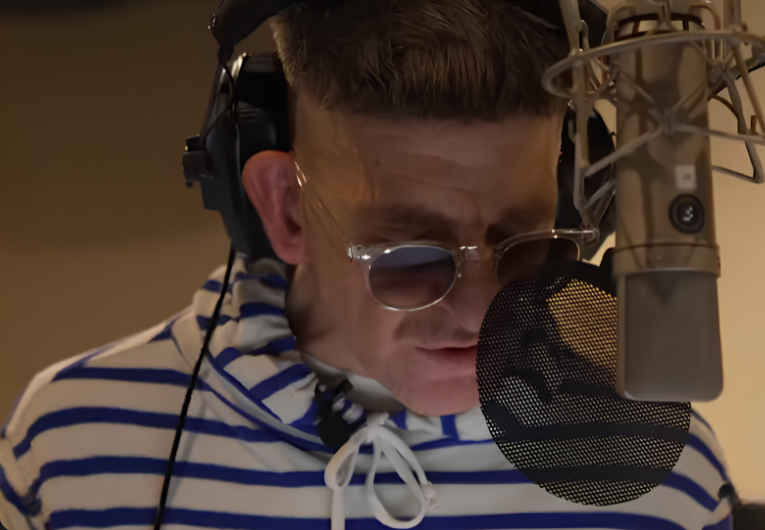
When New York asset manager 1879 Advisors needed to sound established and dependable, actor Billy Baldwin was booked through MN2S to voice the spot. His authoritative delivery over archive footage did in seconds what pages of copy struggle to do: it made a financial brand feel trustworthy.
For the International Olympic Committee’s Stronger Together campaign, Danai Gurira voiced a film contrasting Agnes Keleti, the world’s oldest living Olympic champion, with Team GB’s youngest athlete, Sky Brown. Her closing line, “together we’re stronger than the darkness can ever be,” gave the film its emotional peak.
Fresh recordings also work well in gaming, where the voice is the character. World of Tanks brought back Jon St. John, the voice of Duke Nukem, to record new lines for its Heroes’ Paths crossover, including a fully voiced crew member players could unlock. For fans, the authentic voice is the reward.
Choose this route when you need a specific script, a product message, multiple languages or edits, or a character that has to speak to your brand directly.
Sometimes the smartest move is to cast a voice the audience already links to the world of your story. To build hype for Dereck Chisora vs Deontay Wilder at The O2 in London on 4 April 2026, DAZN did not reach for a standard sports announcer. It cast Paul Anderson to voice its promotional campaign.
Anderson is best known as Arthur Shelby in Peaky Blinders, a bare-knuckle boxer and fight promoter. Viewers already hear that voice and think of fights, grit and menace. His voiceover brought cinematic intensity to the build-up across DAZN’s owned channels and paid media, backed by behind-the-scenes social content.
The lesson for marketers: the right voice does not just read the script. It carries a whole character with it. Match that character to your story and half the creative work is already done.
Route two: license a recording that already exists
Sometimes the best line has already been said, live, at the exact moment people will never forget. Licensing that recording borrows the memory as well as the voice.
For its “Tab Closed” tribute to Lionel Messi, Michelob ULTRA and Wieden+Kennedy New York turned Messi’s World Cup career into an itemised bar receipt. Rather than script new lines, the team looked for existing broadcast commentary and licensed Peter Drury’s original calls to run under the film.
Licensing is also fast. Google Pixel went live on 18 May 2026 with a campaign built around Drury’s live commentary of an Arsenal goal. From first contact to live campaign took under three weeks, and the next evening Arsenal were confirmed as Premier League champions for the first time in 22 years.
Choose this route when the moment matters more than the message, when you are working to a cultural deadline, or when no new recording could match the original.
Getting either route right
Brief the feeling, not just the words. Authority, warmth, nostalgia or adrenaline: pick the emotion first, then the voice that owns it.
Agree usage up front. Channels, cutdowns, territory and term should be settled in one deal. The Pixel licence covered a 60-second film plus 6 and 15-second edits across social, apps, banners and retail partners.
Expect more than one rights holder for existing audio. As with licensing a familiar song, rights can be split across several parties.
Bring the talent with you. A voice who is part of the campaign can share it too. Drury posted the Messi film on his own Instagram.
Find the voice before your competitors do
Whether it is a new script in a voice your audience trusts or a call they already know by heart, the right voice makes an ad feel bigger than its budget. The best ones are booked or licensed early, before the moment arrives.
If you have a campaign that needs a voice, talk to a specialist about recording or licensing it.