



When an actor walks into an ad in character, something entirely different happens and the most commercially powerful partnerships in entertainment marketing are proof of it.
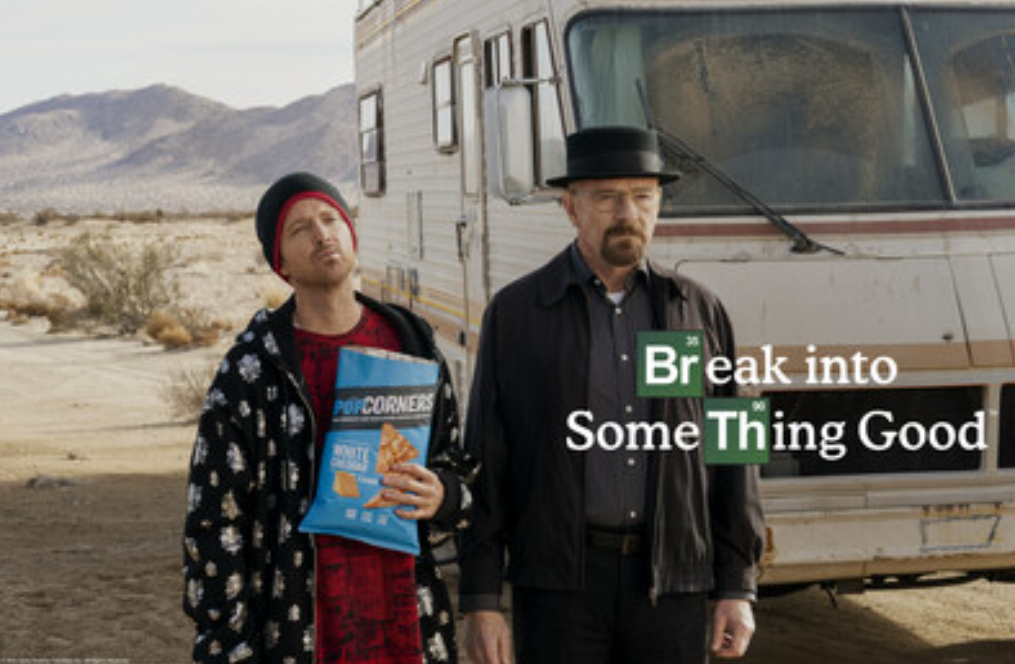
When PopCorners wanted to break through the noise of a Super Bowl ad break, they didn’t just book Bryan Cranston and Aaron Paul. They booked Walter White and Jesse Pinkman. Vince Gilligan wrote and directed the spot. The RV was back. The hazmat suits were back. Tuco Salamanca showed up to taste the snacks. The result wasn’t a commercial. It was a mini-episode of Breaking Bad, and the internet treated it exactly that way.
That distinction matters enormously. Cranston and Paul as themselves are accomplished Hollywood professionals with significant individual profiles. As White and Pinkman, they are arguably two of the most culturally significant characters of the 21st century. The moment PopCorners locked in the character angle alongside the talent, the brief moved from celebrity endorsement to cultural event.
This is a creative strategy with real commercial logic behind it. Brands that understand it are producing some of the most talked-about campaigns in marketing. Those that don’t keep booking famous faces and wondering why the recall numbers are flat.
Nostalgia as a Commercial Asset
There is a reason brands return to this approach so consistently. Nostalgia is not just an emotional response. It is an active purchasing trigger, and consumer behaviour research consistently backs that up. People are more likely to engage with content and convert when they feel emotionally connected to what they’re watching, and nothing creates that connection faster than seeing a beloved character appear somewhere unexpected.
The mechanism is immediate. When Alicia Silverstone walked back into shot in Cher Horowitz’s yellow plaid for Rakuten‘s 2023 Super Bowl campaign, 28 years of cultural memory activated in seconds. Viewers who had grown up with Clueless were already smiling before a single product message landed. Rakuten didn’t need to explain its cashback platform from scratch. It just needed Cher Horowitz, a character defined by a love of shopping to endorse it. The creative brief practically wrote itself.
Similarly, when Macaulay Culkin returned as Kevin McCallister for Google‘s 2018 Christmas campaign, search interest in Home Alone spiked sharply in the days that followed. Google recreated the film’s iconic scenes beat for beat, with Culkin asking his Google Assistant to set reminders, order pizza, and activate “Operation Kevin.” The product demonstration was seamlessly embedded into a scenario audiences already understood and loved. The character provided the context. The brand provided the upgrade.
MN2S Campaigns That Get This Right
At MN2S, we have built a number of partnerships specifically around the relationship between an actor’s screen identity and a brand’s positioning. The results consistently outperform standard celebrity endorsement work, because the character’s cultural equity does the heavy lifting before a single frame is shot.
Chevy Chase and Twinkly is a strong example. MN2S partnered Chase with the smart LED lighting brand ahead of the holiday season, and the creative logic was hard to fault. National Lampoon’s Christmas Vacation remains the most-watched Christmas film year after year. Chase’s character Clark Griswold is, culturally speaking, the definitive emblem of festive home decorating ambition gone gloriously wrong. Booking Chevy Chase to front a campaign for a premium Christmas lighting brand is not just a celebrity partnership. It is a character partnership, and every consumer who associates Chase with Christmas immediately understands why he belongs in that context.
Creed Bratton and Skittles took a similar approach. MN2S brokered the partnership, which saw Bratton channel his famously deadpan, work-shy The Office persona for a Canadian summer campaign titled MFFLP The Rainbow. The campaign’s premise, using a mouthful of Skittles as a socially acceptable way to dodge boring conversations was almost purpose-built for Bratton’s on-screen character. His Office alter ego is legendary for avoiding responsibility and workplace socialising. As Bratton himself put it: “Finding reasons to dodge assignments and skip social events is what I do best.” That quote lands as both a genuine product endorsement and a perfectly in-character line. The campaign ran across TikTok, Instagram, and Snapchat, targeting a Gen Z audience already deeply familiar with Bratton’s Office identity through Netflix reruns.
Vinnie Jones and World of Tanks represents a third variation of this model. MN2S placed Jones within the game’s Holiday Ops event, where he portrayed a tank commander and lent his name to a custom in-game tank skin. Jones’s screen persona, built across roles in Lock, Stock and Two Smoking Barrels, Snatch, and Mean Machine, is defined by physical authority, toughness, and barely-contained aggression. His appeal to the World of Tanks audience is not incidental. It is structural. The character archetype he has built across decades of screen work maps directly onto the game’s identity. The partnership reached his combined social following of close to 500,000 and generated strong engagement precisely because the fit was obvious.
Gabriel Macht and Laverne demonstrates how this works in the luxury and fragrance space. MN2S secured Macht as the face of a commercial campaign for the Saudi Arabian luxury perfume brand, promoting the La’dor Bakhur fragrance. Macht is globally recognised as Harvey Specter from Suits — one of television’s most stylistically aspirational characters: a Manhattan corporate lawyer defined by tailored suits, impeccable taste, and supreme confidence. That persona travels directly into a luxury fragrance context without any creative strain. Laverne gained access not just to a recognisable actor, but to a character whose entire identity is built around refinement and status. For luxury fragrance, that is almost the whole brief.
James Jordan, currently a series regular across two major Taylor Sheridan productions on Paramount+, completed brand campaigns with Jefferson’s Bourbon that drew directly on his screen identity. MN2S’s work with Jordan notes that the partnership ties into the rugged, exploratory themes of Landman, aligning his on-screen persona with Jefferson’s focus on craftsmanship, risk-taking, and discovery. His character’s world is one of frontier ambition and hard terrain. Jefferson’s Bourbon positions itself around the same values. The alignment exists before the brief is even written.
When the Character Does the Strategic Heavy Lifting
The most effective examples of this approach succeed because the character’s existing identity does the brand alignment work automatically. The casting is not a shortcut to credibility. It is the credibility.
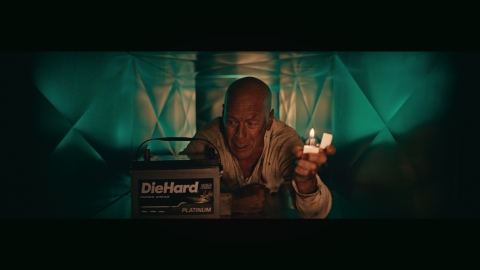
Consider what Bruce Willis achieved for Advance Auto Parts‘ DieHard battery brand. In October 2020, Willis reprised Detective John McClane in a two-minute short film that functioned as a genuine continuation of the Die Hard narrative. Original cast members Clarence Gilyard Jr. and De’voreaux White reprised their roles as villain Theo and limo driver Argyle respectively. The connection between the Die Hard franchise and the DieHard battery brand had always been an obvious piece of wordplay. However, what made the campaign land was the creative commitment to treating it as cinema rather than a throwaway pun. In the official press release, Willis said: “Advance approached this like a motion picture — the script is clever, the production intense and the spot is entertaining. This is what Die Hard fans expect.” The campaign debuted on FOX’s America’s Game of the Week, was covered by Marketing Dive and the Hollywood Reporter, and generated organic shares from Willis’s own family and high-profile entertainment accounts.
The same instinct drove the PopCorners Breaking Good campaign arguably the most talked-about Super Bowl commercial of 2023 and one of the most strategically intelligent character-led brand activations in recent advertising history.
Bryan Cranston and Aaron Paul did not simply say yes to the brief. According to both actors, the decision required genuine creative justification. Cranston told Entertainment Tonight: “The truth is that the PopCorners folks came to us and said, ‘We have an idea.’ And they pitched us with the idea. And we’re very, very protective of the show and the characters. So we listened. We basically laughed and we thought it was really good. It was just so spot-on.” That protective instinct is not a formality. Both Cranston and Paul had already been selective about revisiting the characters — limiting appearances to El Camino in 2019 and the final season of Better Call Saul in 2022. A snack brand commercial required a stronger justification than most projects.
What made the case was the commitment to full creative authenticity. Paul suggested that Vince Gilligan Breaking Bad‘s creator, head writer, and executive producer return to write and direct the spot. PopCorners agreed, and then went further still. The production brought back the screen-used RV from the original series. Raymond Cruz returned as Tuco Salamanca. Original crew members from the show were hired. Cranston told TODAY: “We reviewed the scenes that we were emulating from the series and tweaked the dialogue just a little to make sure that the positioning was right, the dialogue was right. And we use the real RV that we used from the show.” In the official press release, he added: “PopCorners’ desire to create a genuine extension of the franchise and a campaign that would really excite Breaking Bad fans is what brought us back for this Super Bowl commercial.”
The spot, titled Breaking Good, aired in the first commercial break of the third quarter of Super Bowl LVII. Walt and Jesse are back in the RV, this time cooking air-popped snacks instead of Blue Sky. Jesse raves over the chips, Walt delivers his lines with clinical precision, and they bring their creation to Tuco — who approves wildly and demands seven flavours. An extended 90-second cut released online went further, evoking the Ozymandias episode with Walt rolling a barrel of PopCorners through the New Mexico desert in his yellow hazmat suit. The reaction across entertainment and marketing media was immediate. The campaign ranked among the most-watched Super Bowl ads on YouTube that year, covered by Variety, Rolling Stone, and AdWeek.
The Creative Rules That Separate Good from Great
Not every character revival works. The approach carries real risks, and understanding them matters before taking this strategy into a brief.
The first risk is misalignment. The character needs a logical, emotionally coherent reason to be associated with the brand. Cher Horowitz and a cashback shopping platform is a near-perfect fit, because Cher is film’s most iconic shopaholic. Creed Bratton and a brand built around avoiding obligations is equally clean. A character defined by indifference to luxury would not work for a premium fragrance brand, regardless of how famous the actor is.
The second risk is inauthenticity. When the talent has no personal investment in the revival, it shows. The campaigns that perform best are the ones where the actor commits fully to reprising the character rather than simply showing up. Audiences are sophisticated enough to detect the difference between a character appearing because the brand earned it and one appearing because the cheque was sufficient.
The third risk is licensing complexity. Bringing a fictional character into a commercial campaign is not simply a talent booking. It can involve studio negotiations, franchise rights, and the creative involvement of original production teams. That complexity is manageable, but it requires experience and relationships that go well beyond standard talent representation.
Why This Approach Keeps Gaining Ground
The broader shift in celebrity marketing is moving firmly toward cultural relevance over name recognition alone. Audiences respond to campaigns that feel like something happening, not something being sold to them. A character revival, executed well, bypasses the commercial frame entirely. It feels like content first and advertising second.
That dynamic is why this strategy works so consistently across categories. It functions for snack brands, luxury fragrance, gaming platforms, home technology, and spirits. The category is almost irrelevant. What matters is whether the character’s world and the brand’s world genuinely overlap, and whether the creative idea treats that overlap with real commitment.
For brands prepared to think in those terms, the results can be exceptional. The PopCorners campaign generated coverage across entertainment, marketing, and mainstream media simultaneously. The Rakuten Clueless spot became one of the most-discussed Super Bowl commercials of 2023. MN2S’s Chevy Chase x Twinkly campaign turned a smart lighting brand into a genuine Christmas cultural touchpoint. MN2S’s Creed Bratton x Skittles collaboration gave a well-established candy brand a fresh, character-driven route into a younger audience.
The standard in every case was the same: a creative idea that treats the character’s legacy with genuine respect, builds brand messaging around it rather than on top of it, and gives audiences something that feels like a gift rather than an interruption. That is the standard worth aiming for. And for brands willing to work toward it, the commercial rewards are significant.
Book the Character
At MN2S, we work across the full spectrum of talent, entertainment, and brand strategy. We understand that the most commercially potent partnerships often start not with a celebrity’s face, but with a fictional character’s world. Developing the creative logic, navigating rights conversations, identifying which talent will genuinely commit to a revival, and building a brief that actually serves the brand’s audience — this requires a level of access and expertise that goes well beyond standard talent booking.
The best campaigns in this space feel inevitable once you see them. That is the goal. Additionally, for brands willing to think in those terms, the results speak for themselves.
Explore the MN2S talent roster to find your next character-led campaign, or get in touch with our brand partnerships team to discuss your brief.