
 United States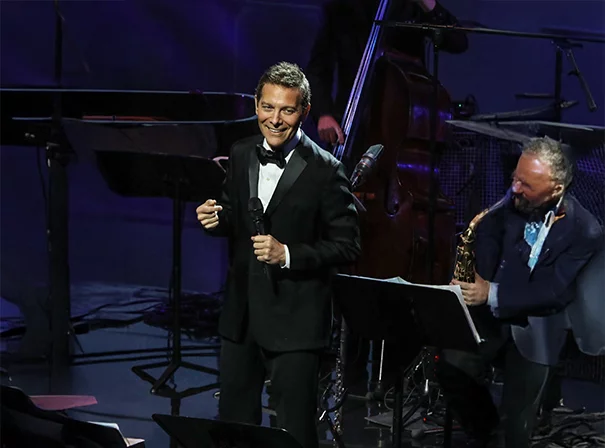

Gwendoline Christie Announced for San Diego Comic-Con Málaga Panel
1 year ago


Michael Feinstein has dedicated his career to preserving and performing the Great American Songbook, transitioning from music archivist to Grammy-nominated recording artist and cultural advocate.
Interested in booking Michael Feinstein?
Request A ShowMichael Feinstein is the artistic director for Allied Solutions Center for the Performing Arts in Carmel, Indiana. The center is also home to the Great American Songbook Foundation.
The Great American Songbook Foundation, founded by Michael Feinstein, entered a multiyear agreement with Carmel-based Forté Sports Medicine and Orthopedics to serve as its title partner.
Michael Feinstein partnered with Brutocao Family Vineyards to create Michael Feinstein Wine, a fusion of music and wine, leveraging the vineyard's reputation for crafting exceptional wines.
Michael Feinstein collaborated with the Indianapolis Chamber Orchestra for 'Celebrate the Songbook,' a concert diving into historic arrangements from the Great American Songbook.
Michael Feinstein is featured as a cultural icon in the podcast 'Stories From The Great American Songbook,' which includes key interviews and explores the legacy of the Songbook.
Michael Jay Feinstein was born on September 7, 1956, in Columbus, Ohio. At age five, he began studying piano but preferred to play by ear rather than reading sheet music. This early inclination shaped his autodidactic approach to music. After high school, Feinstein performed in piano bars for two years before moving to Los Angeles at age 20. In 1977, he was introduced to Ira Gershwin, the lyricist, and was hired to catalog Gershwin’s extensive collection of records. This role expanded over six years to include researching, cataloging, and preserving unpublished sheet music and rare recordings, encompassing works by both Ira and his brother, George Gershwin. During this period, Feinstein also developed a close friendship with singer Rosemary Clooney.
By the mid-1980s, Feinstein had established himself as a nationally recognized cabaret singer and pianist, renowned for his advocacy of the Great American Songbook. His recording career began in 1986 with “Pure Gershwin,” an album celebrating the music of George and Ira Gershwin. This was followed by a series of successful albums, including “Live at the Algonquin” (1986), “Remember: Michael Feinstein Sings Irving Berlin” (1987), and “Isn’t It Romantic” (1988), which marked his first album with orchestral backing. He also brought his talents to Broadway with several in-concert shows, starting in April 1988 with “Michael Feinstein in Concert.” His commitment to the genre led him to significant collaborations, such as serving as musical consultant for the 1983 Broadway show “My One and Only,” a musical featuring Gershwin tunes.
Feinstein’s influence grew beyond performance, leading to the founding of the Great American Songbook Foundation in 2007. The foundation is dedicated to documenting and preserving American popular song, offering educational programs and maintaining an archive. In 2000, the Library of Congress appointed him to the National Recording Preservation Board, recognizing his efforts in safeguarding America’s musical heritage. He later became the artistic director for Allied Solutions Center for the Performing Arts in Carmel, Indiana. His work includes collaborative albums with iconic composers and appearances on television, such as “Michael Feinstein’s American Songbook” on PBS, further cementing his role as a leading interpreter and historian of American popular music.

Curious about our offerings or have inquiries? We're eager to assist!
Just complete the form, and we'll respond promptly.