



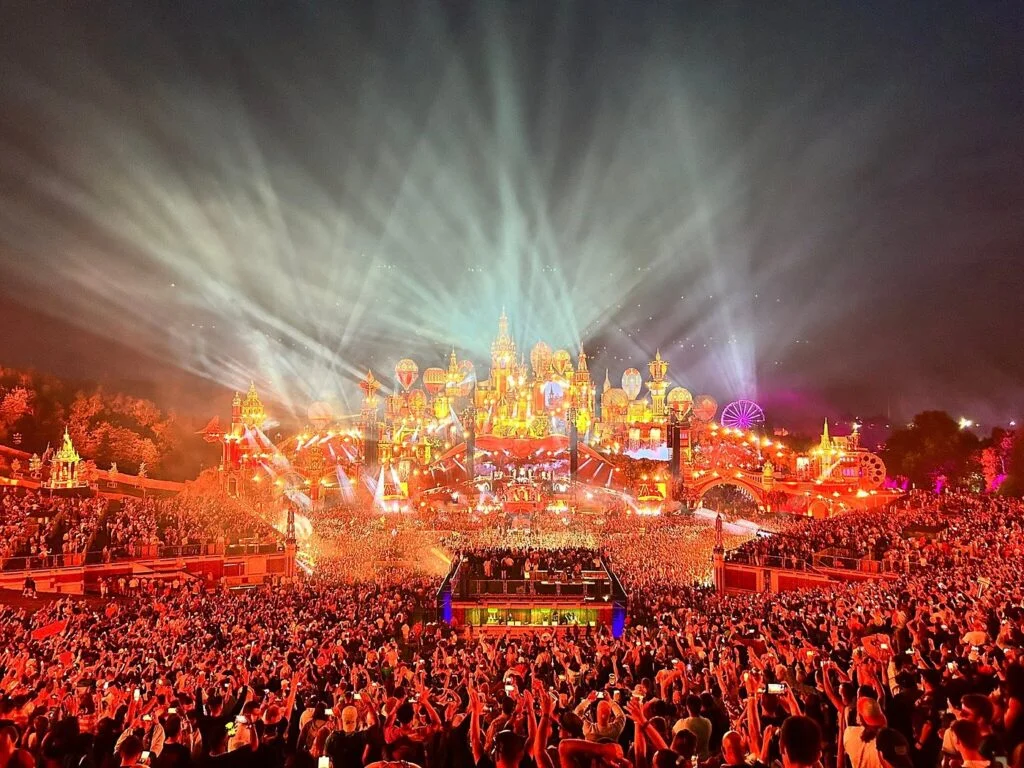
This is not a niche music event. It is one of the most commercially powerful cultural platforms on earth
Every July, the Belgian town of Boom hosts what DJ Mag readers have voted the world’s number one festival for multiple consecutive years. Tomorrowland generates over 250 million euros annually, sells 400,000 tickets across two weekends in under an hour, and commands a pre-registration database of more than four million profiles. Its aftermovies have accumulated over 1.5 billion views. Its audience spans more than 200 countries.
This is not a niche music event. It is one of the most commercially powerful cultural platforms on earth. And for brands in fashion, drinks, tech, and lifestyle, the activation opportunity it presents in 2026 is wider than most marketing teams realise.
Why Tomorrowland Is Different
Most festivals are a place. Tomorrowland is a brand in its own right, with a year-round content universe, a loyal global fanbase, and a commercial ecosystem that operates long before and long after the gates open in Boom. The 2026 edition runs across two weekends, 17-19 and 24-26 July, with more than 500 artists performing across 16 stages, including David Guetta, Martin Garrix, Armin van Buuren, John Summit, Hardwell, Fisher, Dimitri Vegas and Like Mike, and Sara Landry.
The audience that comes with this is specific and valuable. Electronic music festival fans skew young, affluent, and internationally mobile. They are highly active on social media, deeply loyal to the artists they follow, and — critically for brands — they spend. Tomorrowland’s brand partnerships are deliberately curated to create immersive activations rather than passive logo placements, with previous partners including BMW, Off-White, and KuCoin. The benchmark for what brand presence looks like here is high. That is precisely why getting the talent element right matters so much.
The DJ Is Not Just the Entertainment
Here is where most brands get Tomorrowland wrong. They think about the festival as a venue, a place to put up a stand, run a social competition, or slap a logo on a wristband. The brands that actually win at electronic music festivals understand something different: the DJ is the cultural access point.
An artist with a genuine Tomorrowland following is not just a performer. They are a trusted voice inside one of the most fiercely passionate music communities in the world. When that artist partners with a brand authentically, through content, collaboration, or a campaign that reflects who they actually are the brand does not just reach the artist’s audience. It earns a place inside it.
That distinction matters enormously. Electronic music fans are exceptionally good at detecting inauthenticity. A DJ partnership that feels forced or transactional will land badly. One that feels genuine will travel far beyond the festival itself, through social content, streaming platforms, and the year-round digital presence these artists command.
The Talent That Makes It Work
Martin Garrix is among the most recognisable DJs in the world, a Tomorrowland mainstage fixture with a global social media following that gives any brand partner instant cross-market reach. John Summit is the most in-demand name in house music right now, headlining Tomorrowland, Lollapalooza, and Governors Ball in the same summer the kind of heat that brands cannot manufacture and can only align with. Korolova, the Ukrainian melodic techno and progressive house artist with Tomorrowland and Anjunabeats credentials, represents an aspirational, culturally resonant choice for brands targeting a female-forward or wellness-adjacent audience. And MATTN, the Belgian DJ signed to Dimitri Vegas and Like Mike’s Smash The House label and a Tomorrowland veteran, brings both the home-crowd credibility and the mainstage profile that makes local and European brand activations land with conviction.
Each of these artists offers something different. The right choice depends entirely on what your brand is trying to say and who it is trying to reach. That is the conversation worth having now, before the July dates arrive and the window closes.
Beyond the Festival Itself
The smartest Tomorrowland brand strategies do not begin in July and end in late August. They use the festival as the centrepiece of a campaign that runs for months on either side. Content shot ahead of the event. Behind-the-scenes social coverage. Post-festival releases tied to the artist’s sets. Product collaborations timed to the announcement cycle. Tomorrowland’s own aftermovies generate over 1.5 billion views content that lives online for years and pulls audiences back to every brand moment baked into it.
This is the lever most brands leave on the table. The festival is two weekends. The cultural moment it creates lasts considerably longer. Brands that activate through DJ talent rather than around it are the ones that appear in that extended content universe, not just on the day.
The Window Is Now
Tomorrowland 2026 runs from 17 July. Artists are confirming campaign commitments now. Brands that have not yet secured a talent partnership for this summer’s festival circuit are already running behind the curve and the most credible artists at the most credible events will not be available indefinitely.
If your brand has an audience that overlaps with electronic music culture and that audience is far broader than most marketing teams assume this is the moment to act. Get in touch with MN2S to discuss DJ and electronic music talent partnerships for Tomorrowland and the wider summer festival season.