

Neil Harbisson speaks at TikTok Academy: Elevate Leadership Summit
2 years ago


 Spain
Spain
Neil Harbisson is recognized as the world's first officially recognized cyborg artist, whose unique sensory augmentations allow him to perceive color through sound.
Officially Certified British Cyborg Artist Neil Harbisson's First Performance in Japan Two-Day Creative Collaboration Event Exploring Art, ...
Harbisson's experience transitioning into cyborg life hints at the potential for technologically-expanded senses to positively change the way we ...
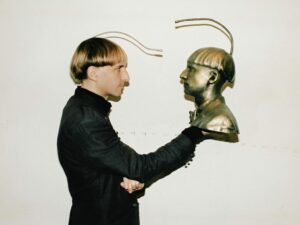
Born in 1982 with achromatopsia, a rare form of complete color blindness, Neil Harbisson grew up in Mataró, Spain, perceiving the world in shades of grey. From an early age, he developed an interest in music, beginning to compose at 11. His artistic journey led him to explore ways of extending human perception beyond natural limitations. In 2004, a turning point occurred when he underwent surgery to implant an antenna into his skull. This ‘eyeborg’ technology converts light waves, including ultraviolet and infrared, into audible vibrations that he perceives through bone conduction, enabling him to “hear” color. This groundbreaking procedure made him the first officially recognized cyborg by a government, as the UK Passport Office accepted his antenna as a body part.
Harbisson’s work is centered on “cyborg art,” which involves designing new senses and organs and integrating them with the body to create new perceptions of reality. He co-founded the Cyborg Foundation in 2010, an international organization dedicated to defending cyborg rights, promoting cyborg art, and supporting individuals who wish to become cyborgs. His artistic creations include “Sound Portraits,” where he translates people’s facial colors into musical compositions, and “Colour Scores,” paintings derived from sounds. He has exhibited his work globally, including at the Venice Biennale, Savina Museum of Contemporary Art, and the American Visionary Art Museum. His activism extends to co-founding the Transpecies Society in 2017, advocating for those with non-human identities and promoting the freedom of self-design. Harbisson has engaged in public lectures and participated in various festivals, contributing significantly to public awareness of cyborgs, transpecies, and human evolution.

Curious about our offerings or have inquiries? We're eager to assist!
Just complete the form, and we'll respond promptly.