

Celebrating the Life of Fatman Scoop: A Legendary Voice in Music
2 years ago


 United States
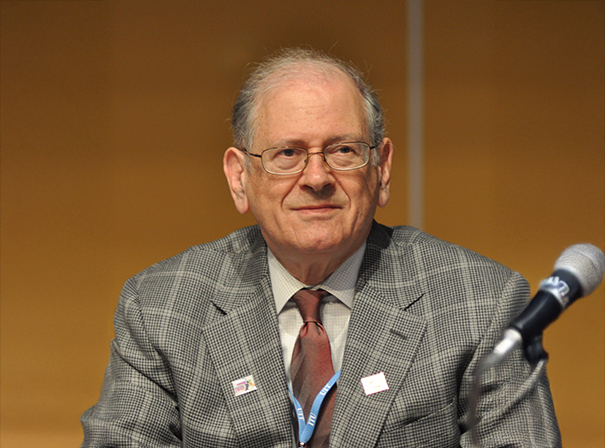
Robert E. Kahn is a pioneering American electrical engineer who co-developed the Transmission Control Protocol/Internet Protocol (TCP/IP), foundational to the internet's architecture.
Inducted Robert Kahn in 2006. In collaboration with Vinton Cerf, Kahn created the Internet architecture, allowing multiple heterogeneous networks to communicate.
Robert E. Kahn is an Internet pioneer who co-invented the TCP/IP protocols and was elected to the National Academy of Sciences.
Awarded Kahn the A.M. Turing Award for his leadership in the design and implementation of TCP/IP, the basis for the current internet.
Featured Drs. Cerf and Kahn in a lecture series discussing their co-design of the Transmission Control Protocol, which became TCP/IP.
Recognizes Dr. Kahn as the conceiver of open-architecture networking, co-inventor of TCP/IP, and originator of DARPA's Internet program.
Inducted Robert Kahn into the Internet Hall of Fame in 2012 for co-inventing the TCP/IP protocols and originating DARPA's Internet program.
Inducted Robert Kahn as a Fellow in 2006 for his technical contributions to internetworking and leadership in applying networks to scientific research.
Awarded Kahn (among others) the Charles Stark Draper Prize in 2001 for his role in developing the Internet.
Robert Kahn served on the board of directors for Qualcomm.
Robert Elliot Kahn was born on December 23, 1938, in Brooklyn, New York. He pursued higher education in electrical engineering, earning his bachelor’s degree from the City College of New York in 1960, followed by an M.A. in 1962 and a Ph.D. in 1964 from Princeton University. Early in his career, Kahn worked at Bell Laboratories and served as an assistant professor at the Massachusetts Institute of Technology (MIT) from 1964 to 1966. A significant turning point in his career came when he joined Bolt Beranek & Newman (BB&N), an engineering consulting firm. Here, he played a principal role in designing the ARPANET’s Interface Message Processor and was instrumental in organizing the first International Conference on Computer Communication in 1972, which showcased packet switching technology to a wider audience.
In 1972, Kahn transitioned to the Defense Advanced Research Projects Agency’s (DARPA) Information Processing Techniques Office (IPTO). Within DARPA, he addressed challenges in deploying packet switching for military radio and satellite networks. This work led to his collaboration with Vinton Cerf on developing the Internet’s architecture and the Transmission Control Protocol/Internet Protocol (TCP/IP). TCP/IP established a fundamental communication framework that allowed diverse computer networks to communicate regardless of their underlying hardware or software. This protocol was adopted as the standard on the ARPANET in 1983, facilitating wide-ranging applications.
After thirteen years with DARPA, Kahn founded the Corporation for National Research Initiatives (CNRI) in 1986, where he continues to serve as chairman, CEO, and president. His work on TCP/IP earned him, along with Vinton Cerf, the Turing Award in 2004 for their pivotal contributions to internetworking. Kahn also initiated the U.S. military’s Strategic Computing Initiative during the Reagan administration and coined the phrase “national information infrastructure.” He has been recognized with numerous awards, including the Presidential Medal of Freedom in 2005 and induction into the National Inventors Hall of Fame in 2006. In 2012, Kahn was inducted into the Internet Hall of Fame and received the Queen Elizabeth Prize for Engineering in 2013.

Curious about our offerings or have inquiries? We're eager to assist!
Just complete the form, and we'll respond promptly.