



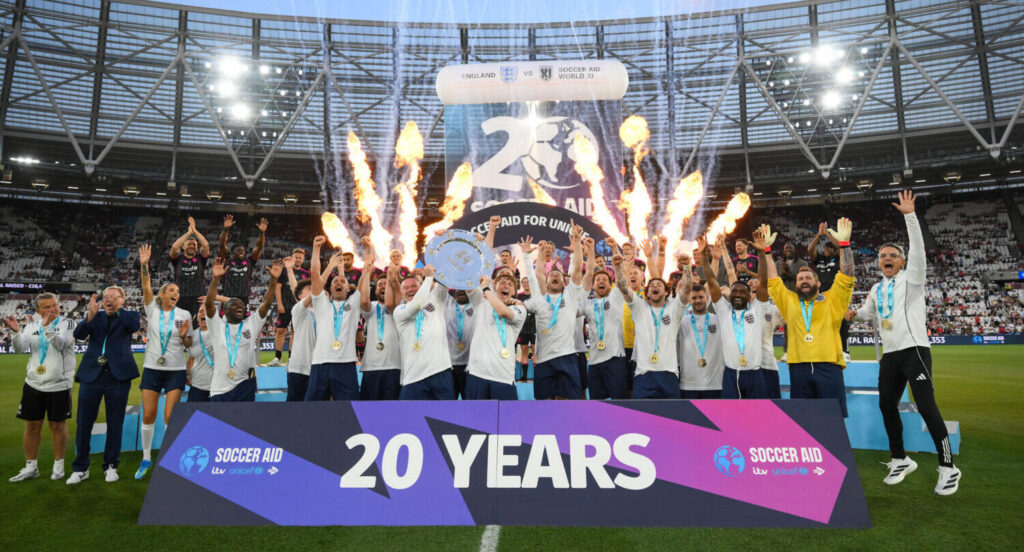
Sixty Thousand People. One Night. £16.5 Million Raised.
The 20th anniversary match at London Stadium on 31 May sold out all 60,000 seats, broadcast live on ITV, and raised £16,462,353 in a single evening, pushing the event’s lifetime fundraising total past £137 million since 2006. Robbie Williams, who co-founded the concept two decades ago, performed at halftime to the biggest stadium crowd of his summer. In the week before the match, Olly Murs ran, rowed, and cycled 400km from Old Trafford to London Stadium, raising over £1.3 million for UNICEF along the way. A Chinese SUV brand followed his every step.
This is not just a charity story. It is a masterclass in what happens when sport and entertainment stop being separate things, and what brands can do when they understand that.
The Entertainment-Led Event Is Outperforming the Sporting Event
Something fundamental has shifted in how audiences relate to live sport. The numbers make it impossible to ignore.
At this year’s Super Bowl, Bad Bunny’s halftime show drew 128.2 million viewers, more than the 124.9 million who watched the game itself. The pattern is consistent. Kendrick Lamar’s 2025 halftime performance pulled 133.5 million viewers, again outpacing the on-pitch action.
The talent is not the support act. The talent is the event.
Soccer Aid understood this from the start. The entertainment logic was baked in from day one: bring together football legends, Hollywood actors, musicians, and comedians; put them on the same pitch; give them a cause worth backing. The result is an event that attracts audiences who would never normally watch a charity football match, because they are not coming for the football. They are coming for the show.
This year that show included Tom Hanks and Tim Allen delivering the match ball onto the pitch. It included Damson Idris making his debut and scoring the opening goal. It included Robbie Williams managing England from the touchline and then performing at halftime. No single category of talent could have generated that audience. The crossover is the product.
Brands Are Starting to Read the Room
CHERY UK, the principal partner of Soccer Aid for UNICEF 2026, did not just sponsor the match. They sponsored the talent. A convoy of TIGGO SUVs followed Olly Murs across five days and 400km of UK countryside, generating broadcast coverage, a primetime ITV documentary, social content, and earned media that no stadium perimeter board could touch. CHERY’s Managing Director called it plainly: a “brilliant celebration of football, entertainment and people coming together.”
That is a brand positioning statement masquerading as a press quote. And it worked.
The smartest brands at sporting events are not the ones with their logo on the boards. They are the ones in the story. Getting into the story means booking the talent, not the inventory.
The Crossover Talent Brief
The Soccer Aid model works because the cast spans industries. That duality is brand gold, and it is something most marketing briefs still fail to ask for explicitly.
When organisations want to attach to sport, whether it is a corporate event, a charity fundraiser, a fan activation, or a branded tournament, they default to booking a former player for a panel, or a DJ for the post-match party. The opportunity is considerably larger.
Football legends with active media careers. Musicians who co-own football clubs. Athletes who are compelling speakers in boardroom settings. These are the people who draw rooms that a single-category booking never could.
The proof is already on the pitch. Here is what that looks like in practice:
Sport meets brand activation. MN2S secured Kevin Kilbane, 110-cap Republic of Ireland international, as a keynote speaker for the EY Ireland Entrepreneur of the Year CEO retreat in Toronto. A room full of business leaders, not football fans, drawn in by the credibility and cross-sector relevance of a football icon. That is the crossover brief working exactly as it should.
Football talent in cultural campaigns. MN2S placed Clint Dempsey, USMNT legend and three-time World Cup scorer, in a Nike x Complex collaboration exploring World Cup sneaker history. Editorial storytelling rather than a straight ad. Football credibility unlocking a streetwear and youth culture audience.
Football legends in World Cup campaigns. Arjen Robben, Ballon d’Or nominee and Champions League winner, fronts Flamin’ Hot’s World Cup 2026 campaign across Mexico, the US, and Canada alongside Maxi Rodríguez. Culturally specific, globally scaled, and anchored by talent that carries instant recognition in all three host nations.
Football characters in entertainment campaigns. Sean Dyche stars in a Snickers integrated campaign that turns one of football’s most frustrating rituals into a moment of branded comedy. The humour only works because the talent is authentic. Casting matters.
Football nostalgia as brand content. MN2S secured Ben Foster for an Emirates FA Cup brand campaign, a goalkeeper turned YouTube creator whose media career gives him a reach and authenticity that a pure pundit booking simply would not deliver.
Also on the MN2S roster: Alan Shearer CBE, the Premier League’s record goalscorer and long-standing supporter of UNICEF and Sport Relief; and Cafu, the most capped Brazilian player in history and founder of a charitable foundation tackling social inequality in São Paulo, both available for sport, charity, and brand contexts globally.
The Window Is Wide Open
The FIFA World Cup is now underway. The Commonwealth Games arrive in Glasgow on 23 July. Wimbledon is days away. The summer of sport is here, and with it the biggest sustained window for brand-sport-entertainment activation of the year.
Most brands will spend their budgets on perimeter boards, social listening tools, and official inventory that costs the earth and gets lost in the noise. The brands that will be remembered did something smarter. They put the right talent on the right stage, in the right context, and let the audience come to them.
Soccer Aid proved across twenty years and £137 million that entertainment-led sport is not a format. It is a force. The pitch is now a stage. The only question is who you book to stand on it.
Build Your Talent Brief
Whether you are activating around a sporting event, producing live entertainment, running a charity campaign, or building a branded experience, working with an agency that holds talent across music, sport, and entertainment means you can brief for the crossover, not just the category.
Check out the MN2S talent roster to book more artists and celebrities.
Related articles
 How to Bring the World Cup Buzz to your Brand Even if You Don’t Sell Football Boots. Here’s Why the World Cup Is Still Your Moment.11 Jun 2026
 You Don’t Need a FIFA Badge to Win the World Cup. You Need the Right Talent.8 May 2026
 Stop Building Events. Start Borrowing Audiences.29 Jul 2026
 From the Parade Ring to the Feed: The New Rules of Royal Ascot Brand Activation4 Jun 2026
 Reactive Talent Marketing should be a Relationship, Not a Scramble16 Jul 2026
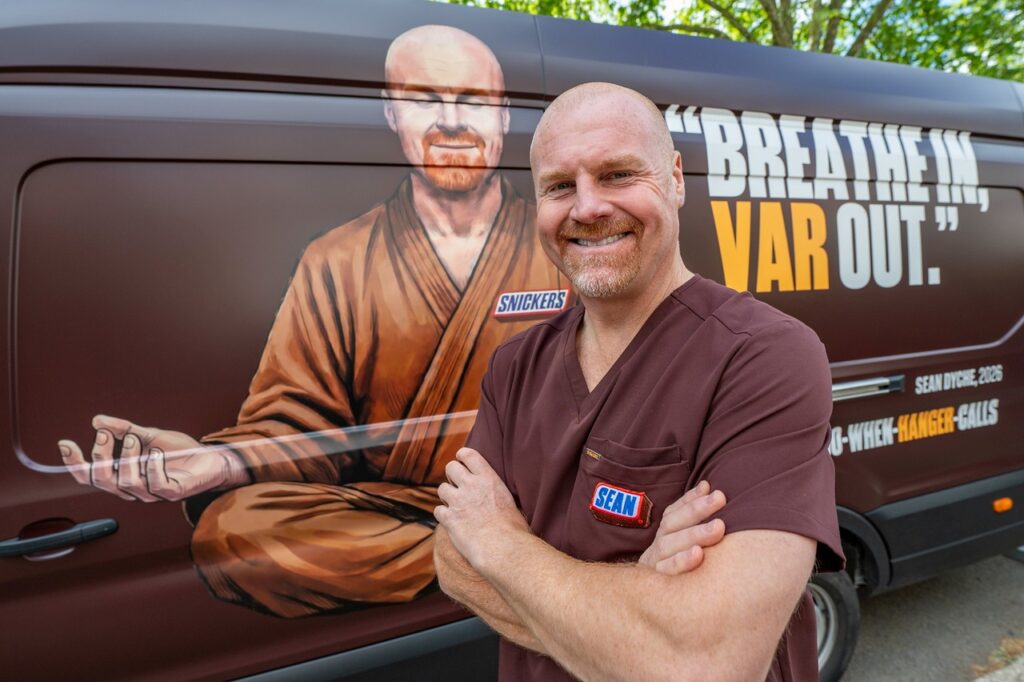 Sean Dyche Teams Up with SNICKERS® to Take On VAR One Bite at a Time15 May 2026